

When the engine is not running, vapors accumulate in the adsorber. After starting the engine, the adsorber is purged with air entering through the hole in its bottom. Gasoline vapor enters the intake manifold and is burned in the combustion chambers.
At idle, the canister purge valve is closed. Only a small amount of vapor enters the cylinders through a fixed diameter hole.
With an increase in engine speed, the vacuum in the intake manifold increases, the canister purge valve opens and vapors begin to be sucked in through the main opening.
Adsorber check
1. Check for leaks when blowing air through port A.
2. Apply a negative pressure of -13 to -20 kPa at inlet A (-100 to -150 mmHg Art.).
3. Close hole D with your hand.
4. Blow in air through inlet C and make sure it flows freely out of hole B.
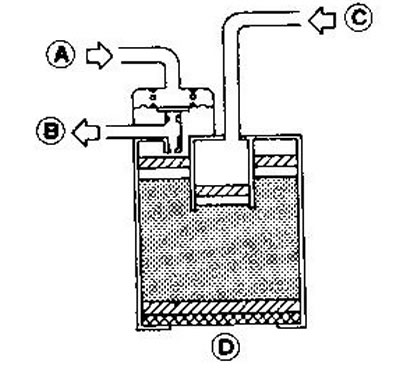
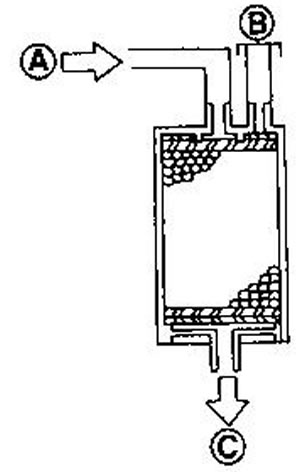
SR engines can be equipped with a simplified canister design. To check it, it is necessary to close inlet B by hand and make sure that the air blown in through inlet A freely exits from hole C.
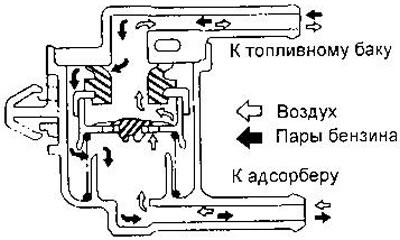
Check valve check
The check valve is located between the fuel tank and the adsorber.
When purging air from the side of the fuel tank, significant resistance should be felt, and part of the air should pass into the adsorber.
When purging from the side of the adsorber, the air must flow freely into the fuel tank.
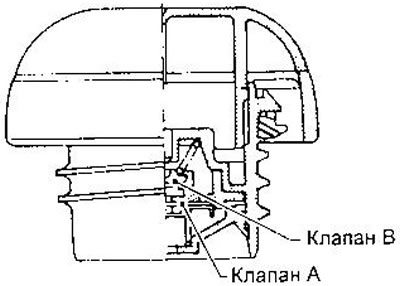
Checking the valves of the fuel cap
1. Clean the plug.
2. When air is sucked through the plug, a slight resistance should be felt, accompanied by clicks of valve A. which indicates its normal state. With further suction of air, the resistance should disappear along with the clicks of the valve.
3. When purging from the fuel tank side, air should exit through valve B. If this valve is clogged or there is no airflow resistance at all, replace the plug assembly.