


Table of contents: Description ↓ Operation of the on-board diagnostic…↓ MI indicator flashes when no DTC is…↓ How to switch diagnostic test modes ↓ Mode I of the diagnostic test -…↓ Mode I of the diagnostic test -…↓ Mode II of the diagnostic test -…↓ Diagnostic Test Mode II - Heated…↓
Description
The malfunction indicator (Ml) is located on the instrument panel.
1. The Ml indicator lights up when the ignition key is turned to the "ON" position with the engine not running. This is done to check the bulb.
If the Ml indicator does not light, see the ELECTRICAL EQUIPMENT chapter.
2. When the engine starts, the Ml indicator should go out.
If the Ml indicator continues to light, it means that the on-board diagnostic system has detected a malfunction in the engine.
Operation of the on-board diagnostic system
The on-board diagnostic system performs the following four functions:
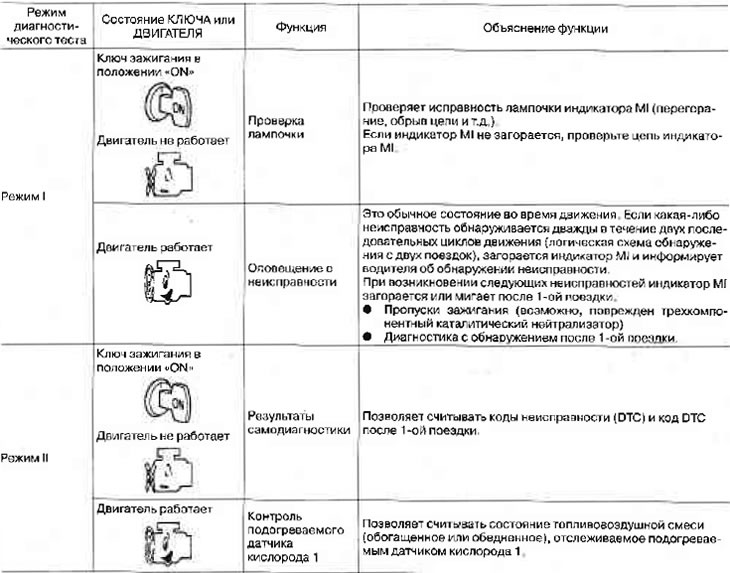
When a malfunction occurs in the engine management system, the ECM cannot alert the driver by illuminating the M1 indicator if there is an open circuit in the latter circuit.
Therefore, if an abnormal condition of the throttle actuator and part of the components associated with the ECM is continuously detected for 5 trips, the ECM notifies the driver that a malfunction has occurred in the engine management system and a break has occurred in the M1 indicator target by activating the emergency mode.
The emergency operation mode is also activated when an abnormal condition of components is detected, except for the Ml indicator circuit, when driver intervention is required to correct the fault.
| Engine operation in emergency mode | The engine speed does not rise above 2500 rpm due to the fuel cut-off |
MI indicator flashes when no DTC is present
If the ECM is in diagnostic test mode II, the Ml indicator may flash while the engine is running. In this case, check the diagnostic test mode the ECM is in.
Clearing the ECM memory will clear the following emissions related diagnostic information:
- diagnostic trouble codes;
- diagnostic trouble codes after 1st trip;
- freeze frame data;
- freeze frame data after 1st trip;
- sRT codes (system operational readiness test);
- test values
How to switch diagnostic test modes
Note:
- It is recommended to keep accurate time using a clock.
- If there is a fault in the accelerator pedal position sensor circuit, switching to diagnostic mode is not possible.
- After turning the ignition key to the "OFF" position, the ECM always returns to the I diagnostic test mode.
How to switch to diagnostic test mode II (self-diagnosis results)
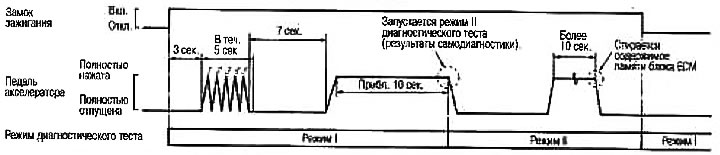
1. Make sure the accelerator pedal is fully released, turn the ignition key to the "ON" position and wait 3 seconds.
2. Repeat the following procedure quickly five times within 5 seconds:
- a. Press the accelerator pedal fully.
- b. Release the accelerator pedal completely.
3. Wait 7 seconds, fully depress the accelerator pedal and hold it down for approximately 10 seconds until the Ml indicator starts flashing.
4. Release the accelerator pedal completely.
The ECM has entered diagnostic test mode II (self-diagnosis results).
How to switch to diagnostic test mode II (heated oxygen sensor 1 control)
1 Switch the ECM to diagnostic test mode II (self-diagnosis results).
2. Start the engine.
The ECM has entered diagnostic test mode II (heated oxygen sensor 1 control).
How to erase data obtained in diagnostic test mode ii (self-diagnosis results)
1. Switch the ECM to diagnostic test mode II (self-diagnosis results).
2. Fully depress the accelerator pedal and hold it down for more than 10 seconds.
Emissions related diagnostic information has been cleared from the ECM backup memory.
3. Release the accelerator pedal completely and check that DTC 0000 is displayed.
Mode I of the diagnostic test - checking the light bulb.
In this mode, the Ml indicator on the instrument panel should light. If it does not light, check the bulb. See the ELECTRICAL EQUIPMENT chapter.
Mode I of the diagnostic test - malfunction notification
| MI indicator | Condition |
| It's on fire | If a malfunction is detected |
| It doesn't burn | There is no malfunction |
The numbers of these DTC codes are explained in the section " Mode II of the diagnostic test (self-diagnosis results)"
Mode II of the diagnostic test - self-diagnostic results
In this mode, the DTC and 1st trip DTC are indicated by the number of flashes of the Ml indicator as shown below.
The DTC and the 1st trip DTC are displayed at the same time. If the Ml indicator does not come on in the I diagnostic test mode (malfunction notification), all displayed data are DTC codes of the 1st trip. If when the Ml indicator lights up in the II diagnostic test mode (self-diagnosis results) only one code is displayed, this is the DTC code; if two or more codes are displayed, they may be either DTCs or 1st trip DTCs. The DTC number is the same as the 1st trip DTC number. These unrecognized codes can be recognized using the CONSULT-II tester or the GST scanner. Let's take any code as an example of reading the code.
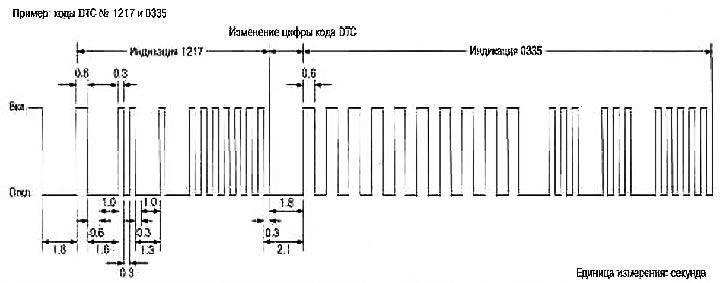
A separate fault code can be determined by the number of flashes that make up a four-digit number. "Zero" is indicated by ten flashes. The time interval during which the fault occurs (lights up and goes out) one flash of the fourth digit of the code, is 1.2 seconds, which consists of the "ON" cycle (0.5 seconds) and "OFF" (0.6 seconds).
The 3rd and other digits of the code consist of the "ON" cycle (0.3 seconds) and "OFF" (0.3 seconds).
The transition from one code digit to another occurs at intervals of 1.0 seconds ("OFF"). In other words, the next digit is displayed 1.3 seconds after the previous one disappears.
The transition from one fault code to another occurs at intervals of 1.8 seconds ("OFF").
Thus, all detected faults are distinguished by the numbers that make up the DTC code. The DTC code "0000" means that there is no fault.
How to clear data obtained in Mode II diagnostic test (self-diagnosis results)
The DTC can be cleared from the ECM backup memory by pressing the accelerator pedal.
When the battery is disconnected, the DTC is cleared from the backup memory within 24 hours.
Do not clear the memory contents before you begin troubleshooting.
Diagnostic Test Mode II - Heated Oxygen Sensor 1 Monitoring
In this mode, the Ml indicator displays the state of the air-fuel mixture (enriched or depleted), monitored by heated oxygen sensor 1.
| Ml indicator | The state of the air-fuel mixture in the exhaust gases | Feedback control state of the air-fuel mixture components |
| It's on fire | Depleted | Closed loop |
| Don't burn#Enriched | ||
| Continues to burn or does not burn* | Any condition | Open loop |
*: Maintains the state only before switching to open loop control.
To check the operation of the heated oxygen sensor 1, start the engine in diagnostic test mode II and warm it up until the engine coolant temperature gauge moves to the middle of the scale.
Then let the engine run at about 2000 rpm for about 2 minutes without load. Check that when the engine runs at 2000 rpm without load, the Ml indicator lights up more than 5 times within 10 seconds.