


1. Using a suitable drift, seat the oil seals into the rear and center cases and the input shaft bearing retainer flush with the component surface. Lubricate the oil seal lips with a lithium-based multi-purpose grease.
2. Lubricate all components with clean oil of the required grade.
3. Place the toothed rings, springs and spacers on the intermediate shaft. Make sure that the springs are installed with the concave side facing the gear. Using a press, install the intermediate shaft bearings.
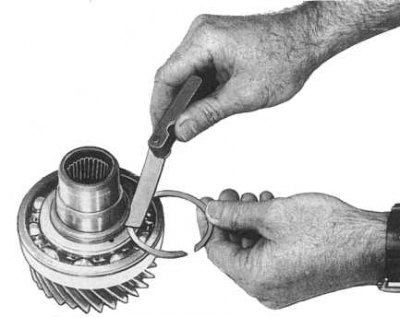
4. Install a spacer ring on the front of the intermediate shaft and measure the lateral clearance between the snap ring and the groove (see accompanying illustration). Compare the measurement result with the regulatory requirements (see size and adjustment tables at the end of the Manual) and select a new retaining ring of the required thickness.
5. Using a press, place the front bearing on the driven shaft (with the screened side facing the driven shaft flange).
6. Install the spacer ring on the driven shaft and measure the lateral clearance between the retaining ring and the groove. Compare the measurement result with the standard requirements (see size and adjustment tables at the end of the Manual) and select a new retaining ring of the required thickness.
7. Lubricate the front bearing of the driven shaft with the required grade of oil and install its holder and the front drive sprocket on the shaft. Lubricate the roller bearing with oil and, rotating the sprocket, put the bearing on the shaft.
8. Install the synchronizer sleeve, sliding keys and spring on the front drive sprocket. Make sure that the sleeve is installed with the groove from the sprocket, the keys with the short ends. Make sure that the keys are correctly engaged with the spring.
9. Align the grooves of the synchronizer locking ring with the keys and place the ring on the drive sprocket. Using a press, install the clutch gear and rear bearing on the driven shaft. Make sure that the bearing is turned with the side equipped with a screen towards the clutch gear.
10. Using a press with support plates, place the bearings on the front output and input shafts. Make sure that the outer snap ring of the input shaft bearing faces away from the gear.
11. Install the spacer ring on the input shaft and measure the lateral clearance between the retaining ring and the groove. Compare the measurement result with the standard requirements (see size and adjustment tables at the end of the Manual) and select a new retaining ring of the required thickness.
12. Install the inner shift lever oil seal into the front housing and lubricate the seal lips.
13. Install the inner shift lever into the front housing. Install the pin, make sure the flat segments of the lever are aligned with it, then tighten the mounting nut securely.
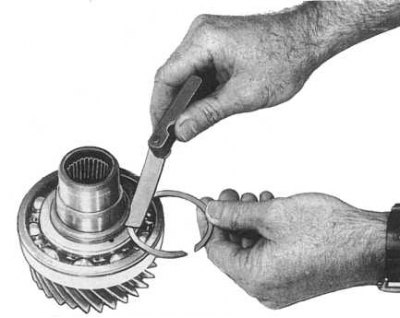
14. Tap the input shaft into the front crankcase with a soft-faced hammer. Lubricate the mating surface of the bearing retainer and the threads of the mounting bolts with Loctite 515 (or equivalent). Tighten the bolts to the required torque (A = 16÷21 Nm; B = 19÷24 Nm - see accompanying illustration). Lubricate the roller bearing with the required grade of grease and place it on the input shaft.
15. Tap the intermediate shaft into the front crankcase with a soft-faced hammer.
16. Install the detent plunger into the front case. Install the shift rods and fork onto the up/down shift clutch and insert the assembly into the front case.
17. Apply sealant to the plugs and install the locking balls and springs. Apply sealant to the 4WD signal switch and, on AT models, the start enable switch.
18. Install the spring and bushing into the 2-4 shift fork, making sure the bushing is oriented as before. Install a new snap ring.
19. Install the 2-4 mode switching fork into the synchronizer clutch and place the drive chain on the drive sprockets of the driven and output shafts.
20. Install the driven and output shaft assemblies evenly into the center crankcase and, using a soft-faced hammer, tap the shafts alternately until the bearings are fully seated. If necessary, install a bearing holder and tighten its bolts to seat the bearing. Tighten the bearing holder bolts to the required torque.
21. Lubricate the roller bearing and install it and the reduction gear onto the driven shaft. Using a suitable drift, fit the up/down hub onto the driven shaft. The hub should be facing the grooves towards the reduction gear. Install the snap ring.
22. Using a blade type feeler gauge, measure the clearance between the underdrive gear and the up/down drive hub. If the air pump axial play is outside the permissible range (see size and adjustment tables at the end of the Manual), remove the gear and hub and replace the defective components.
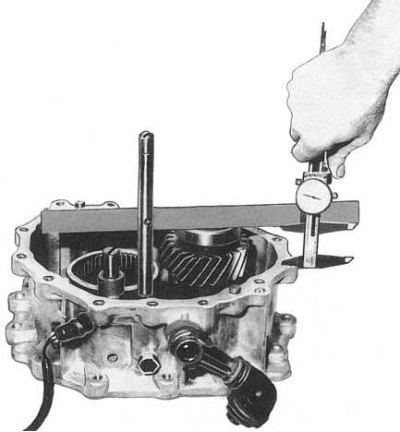
23. Check the value of the intermediate shaft axial clearance (see accompanying illustration):
- Press the flatness gauge against the outer race of the intermediate shaft rear bearing and measure the clearance between the mating surface of the front crankcase and the edge of the flatness gauge (see illustration).
- To determine the required thickness of the adjusting washer, compare the measurement results with the standard data given in the table:
| Gap size, mm | Thickness of adjusting washer, mm |
| 40.6÷40.5 | No washer required |
| 40.5÷40.4 | 0.1 |
| 40.4÷40.3 | 0.2 |
| 40.3÷40.2 | 0.3 |
| 40.2÷40.1 | 0.4 |
| 40.1÷40.0 | 0.5 |
| 40.0÷39.9 | 0.6 |
- If necessary, install an adjusting washer of the required thickness on the intermediate shaft bearing.
24. Lubricate with Loctite 515 sealant (or equivalent)the mating surface of the front case and install the center case assembly, guiding the shift fork onto the shift rod and ensuring that the shafts are correctly positioned.
25. Install the 2-4 shift rod retaining ring, oil drain and speedometer drive gear.
26. Lubricate the internal components of the transfer case with the required grade of grease.
27. Apply Loctite 515 sealant (or equivalent) onto the mating surface and install the rear case. Tighten the mounting bolts in a diagonal pattern to the required torque and install the speedometer drive assembly.
28. Install the transfer case on the vehicle and tighten the drive flange mounting nuts to the required torque.