

Table of contents: Examination ↓ Adjustment ↓
Examination
1. Visually check that the tip of the clutch master cylinder piston rod moves freely without jamming.
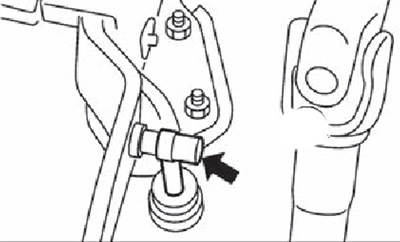
If the tip of the piston rod does not move freely, remove it from the clutch pedal and inspect it for deformation or damage. Leave the tip of the piston rod of the clutch master cylinder removed for the next step.
2. Make sure that the clutch pedal moves freely along its entire travel:
With the clutch master cylinder rod disconnected, manually move the clutch pedal up and down to ensure it moves freely.
If any sticking is detected, it must be replaced with a new one. Again, make sure that the tip of the clutch master cylinder rod moves freely.
3. Check the position of the ASCD switch (automatic speed control):
If the clutch master cylinder tip does not move freely, make sure the ASCD switch is not applying pressure to the clutch pedal, causing the tip to stick. To adjust the switch position, disconnect the electrical connector and rotate the ASCD switch.
(Data taken from this portal NISSANBOOK.RU)
Connect the ASCD switch electrical connector.
4. Check the clutch hydraulic drive components (clutch master cylinder, concentric release cylinder) for jamming or binding.
If any jamming or sticking is detected, eliminate the cause of the malfunction or replace its parts with new ones.
If it is necessary to perform repair operations on any of the components of the clutch hydraulic drive, perform the procedure for bleeding the clutch hydraulic drive after completing the repair.
Note: Do not use a vacuum attachment or any other type of special device to forcefully bleed the clutch hydraulic system, as they will not completely remove air from the system.
Adjustment
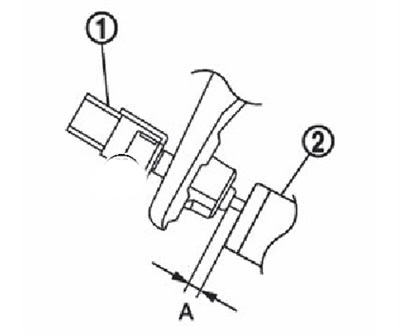
Adjust the position of the ASCD switch (1) so that the gap "A" between the clutch pedal (2) and the threaded part of the ASCD switch with the pedal fully released corresponds to the set value (0.74-1.96 mm).