


Caution: To avoid being scalded by coolant, never remove the coolant expansion tank or radiator cap when the engine is hot. Liquid squirting out from the radiator or expansion tank cap can cause severe burns. Wait until the engine and radiator have cooled down.
The engine cooling system is filled at the factory with high-quality coolant, which is designed for year-round use and has a long service life. The coolant has a low freezing point and contains a complex of anti-corrosion additives, so additional additives are not required.
Attention:
- For topping up and replacement, use only the original Nissan Antifreeze Coolant L250 (50%/50% ratio with distilled water).
- Using other coolants may damage the engine cooling system.
- If your vehicle's radiator is designed to use a plug, you must use a genuine NISSAN plug.
Checking the coolant level
The coolant level in the expansion tank is checked on a cold engine. If the liquid level has dropped below the "MIN" mark ②, which is applied to the wall of the expansion tank, then you should add liquid and bring its level to the "MAX" mark ①. If there is no coolant in the expansion tank at all, check the liquid level in the radiator (only on cold engine). If necessary, add the recommended coolant to the radiator and bring its level to the base of the neck. Then add liquid to the expansion tank up to the "MAX" mark.
|
Version A
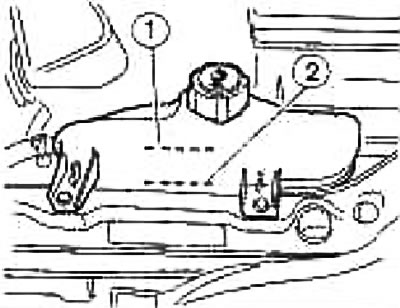 |
Version B
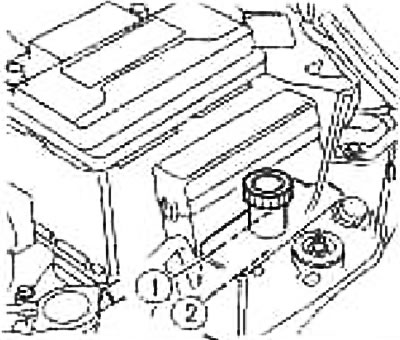 |
Note: If you have to top up the coolant quite frequently, contact a service station to have the engine cooling system checked.