


Examination
1. Loosen the wheel nuts, lift the car and place it on stands. Remove the wheels.
2. Remove the caliper with the cylinder and set it aside.
3. Check the condition of the disc. If traces of deep wear are found, (depth more than 0.38 mm) remove the disc and sand it (photo).
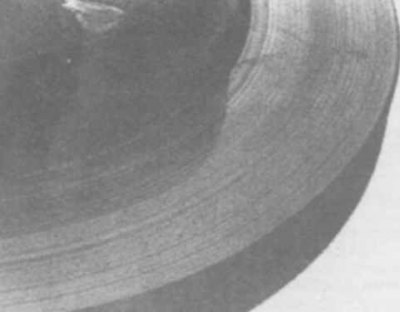
4.3. Brake disc surface
4. Check the runout (especially if vibrations were felt when braking) using a pointer indicator (photo). If the runout on the indicator exceeds the norm, remove the disk and grind it.
Attention! It is generally recommended to periodically remove the disk and polish it depending on the indicator readings. At least this can be done by hand with fine sandpaper (photo) to reduce roughness.
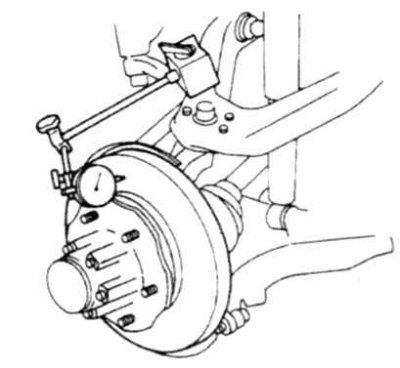
4.4a Checking disc runout
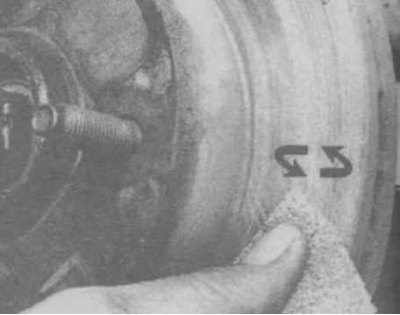
4.4b Grinding the disc by hand
5. After grinding, the thickness of the disc should not be less than the maximum permissible value (thickness cast on disk, photo).
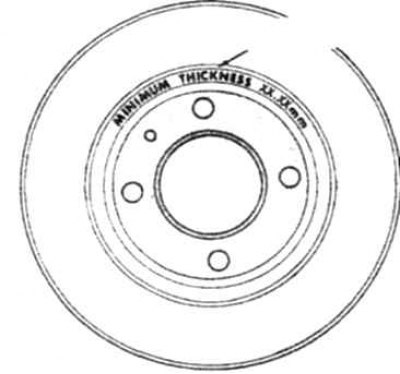
4.5a Place of application of the maximum disk thickness
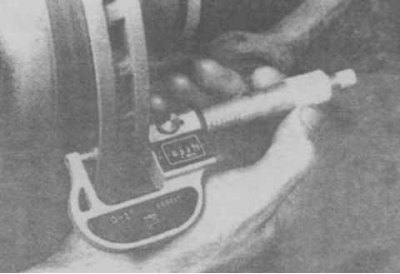
4.5b Checking the thickness of the disc. Measure the thickness in several places
Removal
6. Remove the hub dust cover.
7. Remove the cotter pin.
8. Remove the cap.
9. Unscrew the hub nut and remove the washer.
10. Remove the outer bearing.
11. Remove the hub assembly with the disc.
12. If the disk is to be reground, remove: the oil seal.
13. If the disk is to be changed, separate it from the hub by unscrewing the bolts, tapping the edge of the hub, prying it up with screwdrivers and removing the disk (photo). If you cannot separate the disk in this way, lubricate the joint between the disk and the hub with penetrating liquid.
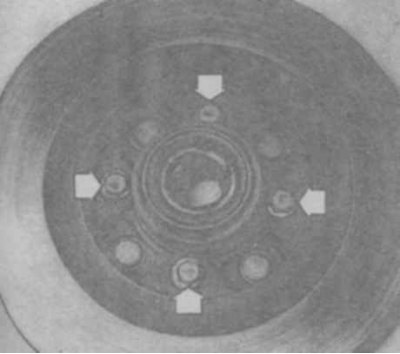
4.13a Disc to hub mounting bolts
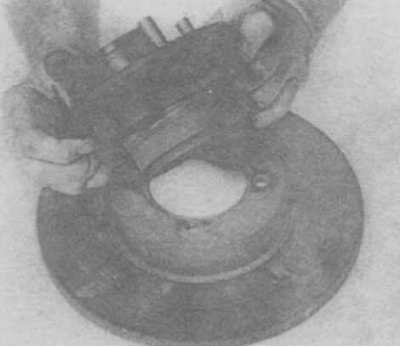
4.13b Separating the disc and hub
Installation
14. Install the disc on the hub and tighten the bolts.
15. Tighten the bolts evenly and gradually until snug.
16. The remaining operations are performed in accordance with Ch. 11.