


Table of contents: Early model years (until 1992.) ↓ Models of later years of production…↓
Note: The following special tools are required to perform the procedures described below: a bipod puller and a 41 mm socket or open-end wrench (to remove the mechanism); replaceable head type TORX E10 (to disassemble the mechanism); sensitive torque wrench and adapter for preload adjustment (for assembly).
Early model years (until 1992.)
Adjustment
Note: Do not attempt to adjust the steering gear without using a sensitive torque wrench - this may result in reduced vehicle handling and reduced life of the steering gear components.
Removal
1. Set the front wheels and steering wheel to the straight-ahead position.
2. Mark the position of the flexible coupling in relation to the steering gear worm shaft with quick-drying paint. Unscrew the tie bolt.
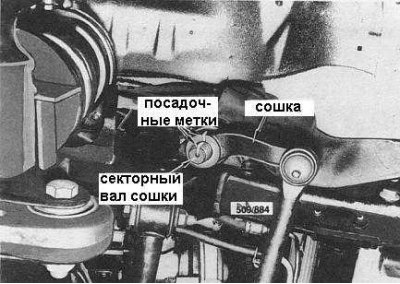
3. Loosen the nut securing the steering knuckle to the sector shaft, remove the washer. Mark the position of the steering knuckle relative to the sector shaft (see accompanying illustration). Using a special puller, remove the bipod from the sector shaft.
4. Loosen the hollow bolts that secure the hydraulic lines to the steering gear assembly. Place a drain pan under the lines to collect any leaking fluid.
5. Loosen the nuts and bolts securing the steering gear to the chassis. Remove the steering gear assembly from the vehicle.
Installation
Installation is carried out in reverse order.
1. Make sure that all the landing marks applied during dismantling are aligned.
2. Install the steering gear assembly mounting nuts and bolts. Tighten the fasteners to 84÷96 Nm.
3. Replace the copper sealing washers in the nipple connectors and tighten the hollow bolts securely.
4. Tighten the steering knuckle mounting nut to 235÷265 Nm.
5. Add fresh fluid to the reservoir and bleed the hydraulic system.
Disassembly
1. Remove the steering gear assembly from the vehicle.
2. Bring the worm shaft to the middle (rectilinear) position by turning it 2.14 turns (two full turns, plus another 50°). Back from the stop.
3. Loosen the sector shaft cover mounting bolts and use a soft-faced hammer to knock the shaft out of the steering gear housing by approximately 20 mm, then remove it by hand.
Note: After removing the sector shaft, do not allow the booster piston or worm shaft to move.
4. Carefully pry off the boot from the end of the steering gear housing on the pitman arm side. Discard the boot.
5. Remove the retaining ring and remove the large spacer sleeve by carefully prying it off with a suitable lever.
6. Carefully remove the oil seal from the steering gear housing - do not scratch the sealing surface of the housing with the lever.
7. Using a TORX E10 key, loosen the rear cover mounting bolts.
8. Carefully remove the rear cover together with the booster piston and worm shaft from the steering gear housing. Try not to allow the components to shift to avoid the circulation balls falling out.
Note: Vehicle manufacturers insist that if the clearance between the piston and the rear cover exceeds 35 mm, the piston and worm shaft assembly must be replaced.
9. Check the condition of the roller bearings, worm shaft bearings, sector shaft and worm shaft assembly with reinforcement piston. Replace excessively worn or damaged components.
Steering gear components
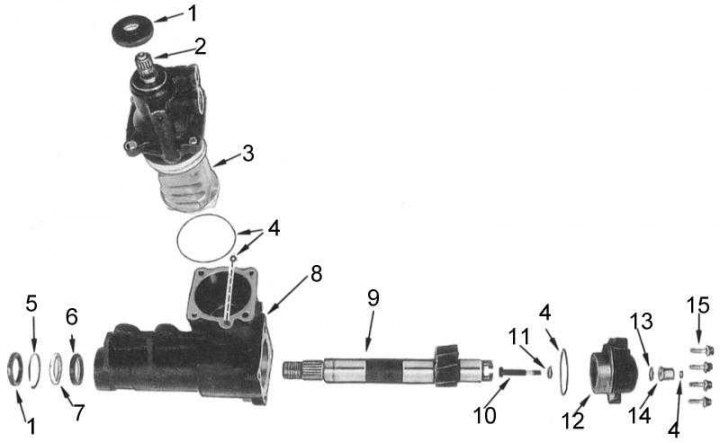
1 - anther; 2 - worm shaft; 3 - reinforcing piston; 4 - sealing rings; 5 - retaining ring; 6 - oil seal; 7 - spacer sleeve; 8 - crankcase; 9 - sector shaft of the bipod; 10 - adjusting screw; 11 - adjusting washer; 12 - lid; 13 - washer; 14 - lock nut; 15 - bolts
Assembly
Assembly is carried out in the reverse order of disassembly.
Note. Replacement of sealing rings, spacer bushings, oil seals, retaining rings and washers must be performed every time the steering gear is disassembled. This means that in order to assemble the gear, you should purchase a special repair kit containing all the necessary replacement components.
1. Lubricate all components with hydraulic fluid before assembly.
2. Apply a suitable sealant to the new rear cover seal and install and seat it in the steering gear housing using a piece of pipe resting on the outer perimeter of the seal. Make sure that the seal is facing the main jaws towards the reinforcement piston.
3. Install new sealing rings and Teflon rings into the rear cover. For temporary fixation, lubricate the rings with technical petroleum jelly.
4. Install the worm shaft, reinforcement piston and rear cover into the steering gear housing. Try not to damage the Teflon ring on the end of the piston. Make sure that all the sealing rings are installed in their places.
5. Screw in the rear cover mounting bolts and tighten them diagonally in two or three stages with a final torque of 26÷32 Nm.
Note: The booster piston must be in the normal working position and not be tilted.
6. Lubricate the new sector shaft seal on the outside along the perimeter with a suitable sealant, then seat it perpendicularly in the steering gear housing using a piece of pipe that should rest against the outer edge of the seal. Moderately lubricate the seal bends with technical petroleum jelly.
7. Install the large spacer sleeve into the steering gear housing and secure it with the retaining ring. Make sure that the rounded edge of the retaining ring faces the seal.
Note: On some models, the rounded edge side of the seal is marked with an identification mark in the form of the letter R.
8. Install a new boot into the steering gear housing, seating it using a piece of pipe resting against the outer edge of the boot. Lightly lubricate the boot lips with petroleum jelly.
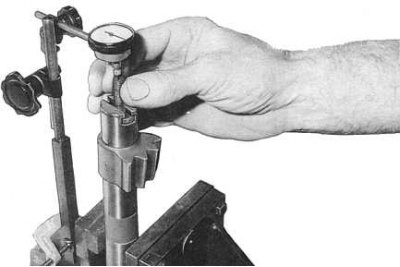
9. Check the axial clearance of the sector shaft (see accompanying illustration), if necessary, make adjustments:
- Clamp the sector shaft in a vice with soft jaws.
- Place the dial gauge with the plunger towards the end of the adjusting screw, then move the screw up and down the entire length of its stroke and read the instrument readings. The nominal value of the axial play of the sector shaft is 0.01÷1.05 mm.
- If necessary, remove the adjusting screw from the shaft and install new adjusting washers of the required thickness. If the nominal value of axial clearance cannot be achieved, replace the adjusting screw.
10. Install a new sealing ring on the sector shaft cover. Lightly lubricate it with petroleum jelly. Using a small, sharp tool, remove the sealing ring from the sector shaft adjusting screw lock nut. Using a blunt tool, install a new sealing ring, having previously lubricated it with petroleum jelly.
11. Turn the worm shaft to drive the booster piston to a straight position.
12. Wrap the sector shaft splines with tape.
13. Turn the booster piston with the teeth facing upwards, towards the top of the steering box, at an angle of approximately 10°÷15° to ensure free installation of the sector shaft.
14. Install the sector shaft into the crankcase. Make sure that the booster piston remains in the central position.
15. Screw in the sector shaft cover mounting bolts and tighten them diagonally in two or three stages with a final torque of 26÷32 Nm.
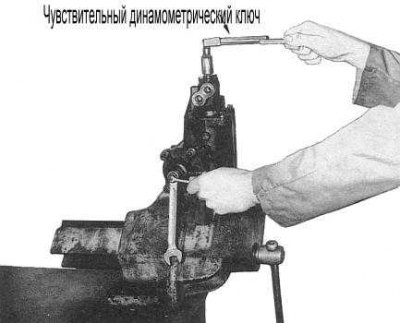
16. Clamp the steering gear assembly in a vice at approximately the normal installation angle and check the turning force.
- Rotate the worm shaft from lock to lock several times to seat the steering gear components
Note: If the worm shaft rotates jerkily or has binding points, adjust the adjusting screw accordingly.
- Using a sensitive torque wrench with a suitable attachment, measure the worm shaft turning force. The measurement is taken from the straight-line position of the shaft. The nominal value is 0.59÷1.34 Nm.
Note: If you don't have a suitable socket on hand, you can tape the end of the shaft and use a tight-fitting polygon socket.
- Repeat the checking procedure after rotating the worm shaft 360° from the center position. This time, the nominal value is 0.2÷0.4 Nm less than the above.
- If the worm shaft turning force falls within the specified values, tighten the lock nut with a force of 34÷40 Nm, while holding the adjusting screw motionless.
- If the shaft turning force exceeds the permissible limits, adjust the position of the adjusting screw accordingly. If the force cannot be brought within the norm, the steering gear assembly must be replaced.
17. Install the steering gear assembly onto the vehicle.
[The source of the article is on the website: nissanbook.ru]
Models of later years of production (since 1992)
The above procedure remains in force subject to the following comments:
- The sector shaft boot, locking ring and spacer sleeve have been removed from the steering gear assembly. The adjusting screw lock nut sealing ring with washer has also been removed.
- An additional flexible seal is installed between the outer seal of the sector shaft and the roller bearing in the crankcase. This seal must be seated with the grooved side facing the bearing.
- A flexible seal is also installed on the sector shaft cover. The grooved side must face the bearing.