


Table of contents: Cars without a catalytic converter ↓ Cars with a catalytic converter ↓
Carburetor parts on cars without a neutralizer
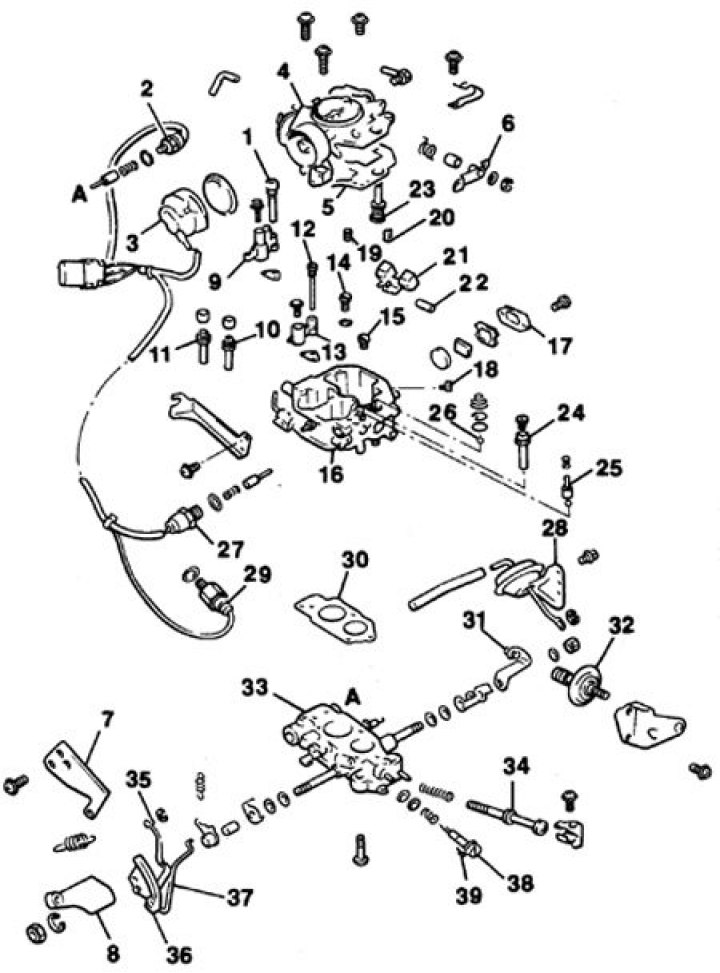
1. Secondary chamber emulsion tube; 2. Idle speed correction solenoid valve; 3. Thermoelectric actuator of the air damper; 4. Air damper housing; 5. Float chamber gasket; 6. Accelerator pump lever; 7. Bracket; 8. Bracket; 9. Secondary chamber diffuser; 10. Economizer jet; 11. Idle speed correction jet; 12. Primary chamber main air jet; 13. Small diffuser of the primary chamber; 14. Economizer valve; 15. Primary chamber main fuel jet; 16. Body; 17. Float chamber inspection window; 18. Secondary chamber main fuel jet; 19. Primary chamber idle jet; 20. Needle valve; 21. Float; 22. Axis; 23. Accelerator pump piston; 24. Primary chamber emulsion tube; 25. Accelerator pump check valve; 26. Accelerator pump valve; 27. Fuel cut-off solenoid valve; 28. Secondary chamber diaphragm; 29. Accelerator pump coil; 30. Gasket; 31. Adjusting screw; 32. Throttle damper; 33. Body; 34. Adjusting screw; 35. Air damper thrust; 36. Throttle lever; 37. Accelerator pump rod; 38. Mixture quality screw; 39. Limiting sleeve
Cars without a catalytic converter
Nikki 21L carburetors are dual-chamber, with a falling flow and automatic air damper. The secondary chamber throttle valve opens under the action of a pneumatic drive.
The carburetor body consists of three sections, the middle section is separated from the throttle section by a heat-insulating spacer.
A screw with a conical end is provided to adjust the idle speed. Fuel cut-off is provided by an electromagnetic valve.
For additional enrichment of the mixture at full engine load, an economizer jet is provided.
The mixture preparation system in normal engine operation mode includes the main fuel jet, emulsion tube, air jet and small diffuser.
For additional fuel injection during sharp acceleration, an accelerator pump is provided, which is driven by a rod connected to the throttle lever. The fuel dose of the accelerator pump is regulated depending on the engine thermal conditions by an electromagnetic valve controlled by a thermal switch.
The idle speed adjustment screw is covered by a limiting sleeve.
Automatic increase in idle speed when additional load is applied to the engine (for example, when turning on the headlights or air conditioning) is provided by a bypass electromagnetic valve.
The air damper is equipped with a thermoelectric drive, which is a spiral bimetallic spring heated by the flowing current.
Cars with a catalytic converter
The carburetors of these vehicles are equipped with a low-inertia electromagnetic valve to maintain the stoichiometric composition of the combustible mixture, which is controlled by the processor unit (this unit also controls the ignition timing).
Signals from sensors are sent to the processor unit.
The main control signals are signals from the air flow pressure and crankshaft angle sensors (the steering angle sensor is mounted in the ignition distributor).
Additional sensors, based on signals from which the mixture composition is regulated, are:
- coolant temperature sensor;
- throttle switch;
- transmission neutral position sensor;
- clutch release sensor;
- vehicle speed sensor;
- exhaust gas sensor.
The control unit compares the incoming information and generates signals that control the ignition timing, the fuel mixture stabilization valve, idle speed, etc., providing optimal conditions for starting and operating the engine in various thermal conditions.
To reduce the toxicity of exhaust gases and maintain traction qualities on a cold engine, an electric heater is installed between the manifold and the carburetor. After the engine warms up, the control unit closes the cut-off valve, which increases efficiency and reduces the toxicity of emissions into the atmosphere.
Some vehicles are equipped with recirculation and additional air intake systems.