


Removal
1. Disconnect the negative cable from the battery.
Warning! If the car stereo system is equipped with a security code, make sure you have the correct combination to activate the audio system before disconnecting the battery!
2. Loosen the right front wheel nuts. Set the parking brake and chock the rear wheels.
3. Jack up the front of the car and place it on supports.
4. Remove the right front wheel and its arch protection liner (see Chapter Body).
5. Remove all drive belts (see Chapter Settings and ongoing maintenance).
6. Remove the crankcase guard and drain the cooling system (see Chapter Settings and ongoing maintenance).
7. Remove the spark plugs (see Chapter Settings and ongoing maintenance). Bring the piston of the first cylinder to the TDC position of the end of the compression stroke (see section Bringing the piston of the first cylinder to the top dead center (TDC) position).
8. Disconnect the radiator and bypass hoses from the thermostat housing. Remove the water pump pulley.
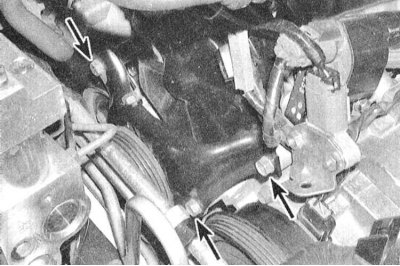
9. Remove the intermediate roller of the A/C compressor drive belt with its bracket.
10. Remove the crankshaft pulley (see section Removal and installation the crankshaft pulley).
Note: Do not allow the crankshaft to rotate while removing the pulley, as this will move the engine out of TDC.
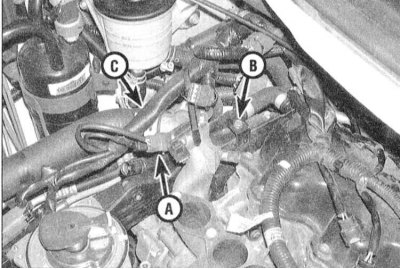
11. Release the electrical wiring and hoses from the retainers on the upper timing belt cover.
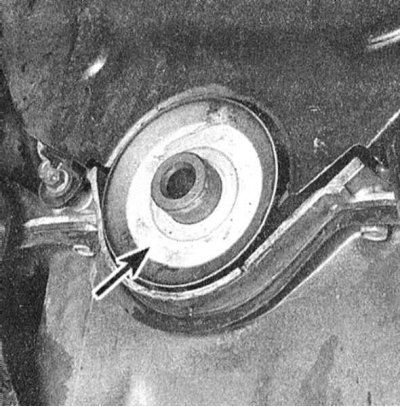
12. Remove the crankshaft journals and timing belt guide, then unscrew the upper and lower belt cover mounting bolts. Please note that bolts of different sizes are used to secure the covers, which must be screwed in exactly in their original places during assembly - mark the bolt heads accordingly.
13. Make sure that the piston of the first cylinder is in the TDC position at the end of the compression stroke - the marks on the gear wheels of the camshafts and crankshaft must be correctly aligned with the corresponding indicators.
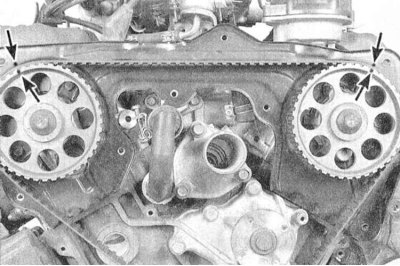
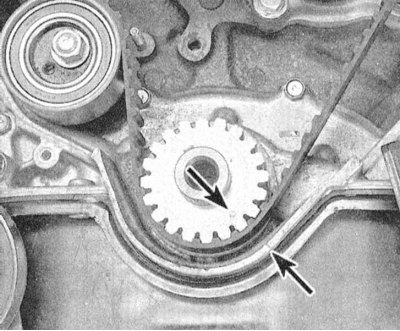
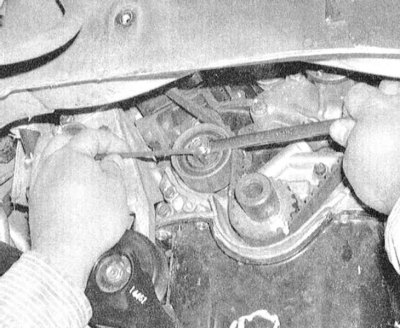
14. Loosen the lock nut by half a turn and turn the tensioner 70-80 degrees clockwise to loosen the tension on the timing belt.
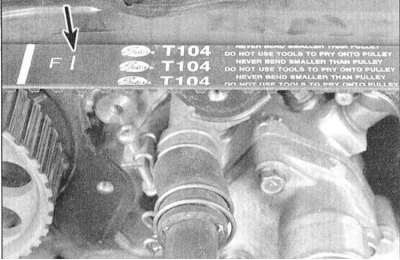
15. Check the belt for markings indicating the direction of its orientation when installed on the engine. If necessary, apply the appropriate markings yourself using chalk or paint.
The article is located on the website: nissanbook.ru
Note: This requirement only makes sense if the old belt is not going to be replaced. Remove the belt from the timing gear and carefully inspect for cracks, signs of wear, traces of contamination with oil or coolant. Replace the belt if necessary. Assess the degree of wear of the tensioner assembly with the spring, make sure the roller rotates smoothly.
16. Assess the condition of the gear wheels - if signs of excessive wear or mechanical damage are detected, replace the wheels.
Note: The only time the gears need to be removed is if they are damaged or to gain access to other components, such as when replacing the cylinder heads, oil pump, front crankshaft oil seal, or rear timing belt cover.
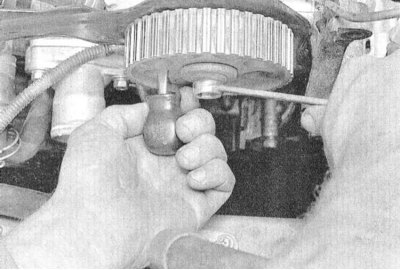
17. Insert a screwdriver into the hole in the camshaft gear, lock it from turning and loosen the mounting bolt.
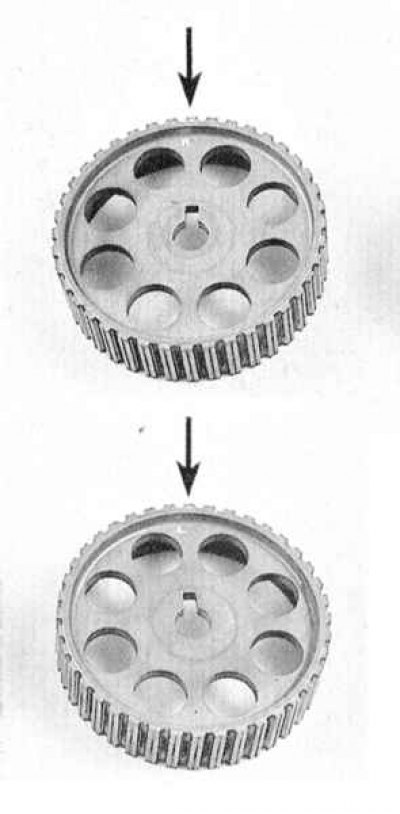
18. After the bolt has been unscrewed, the gear wheel must be removed from the shaft journal by hand.
Note: The right and left camshaft gears are not interchangeable and are marked accordingly.
19. The procedure for replacing the crankshaft gear is described in Section Replacing the front crankshaft oil seal.
Installation
1. Make sure that the new belt you have prepared corresponds to the dimensional characteristics of your car engine. New belts usually have three white markings, the presence of which allows you to significantly simplify the procedure for installing components and aligning them relative to the installation marks.
Note. Also make sure that the geometry of the belt teeth corresponds to the design of the timing gear wheels. On some early models, the lower edges of the grooves between the gear teeth may be rectangular, on others they are rounded. - the belt teeth must have the appropriate shape. Violation of this requirement leads to an increase in noise during engine operation and to premature wear of the belt.
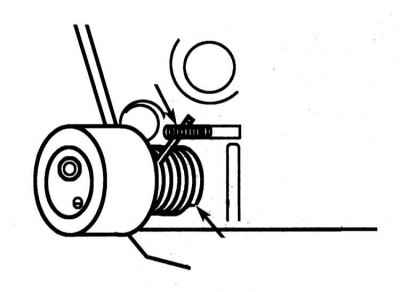
2. If you removed the tensioner, reinstall it, making sure the spring is seated correctly. Prepare to install the belt by turning the tensioner clockwise with a bar wrench. Temporarily lock the tensioner in this position by tightening the lock nut.
3. Making sure that the timing marks are aligned correctly, place the belt on the timing gear wheels. Moving counterclockwise and trying not to leave any slack, first place the belt on the crankshaft wheel, then place it on the left (front) camshaft wheel, then place it on the right (rear) camshaft wheel. Finally, place the belt under the tensioner roller.
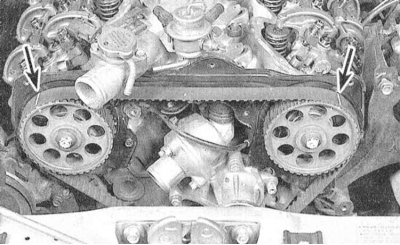
4. Manually take up the slack on the belt side of the tensioner, then loosen the tensioner nut and rotate the assembly 70÷80 degrees counterclockwise. Tighten the lock nut. Make sure that all three sets of timing marks are aligned correctly and that the belt is installed with the correct side forward.
5. Slowly rotate the crankshaft clockwise two full revolutions, finally returning it to the TDC position at the end of the compression stroke.
Caution! Excessive resistance to turning of the shaft indicates that the pistons are coming into contact with the valves and, before continuing to turn the shaft, it is necessary to return to the initial position and make the appropriate adjustment of the TDC position.
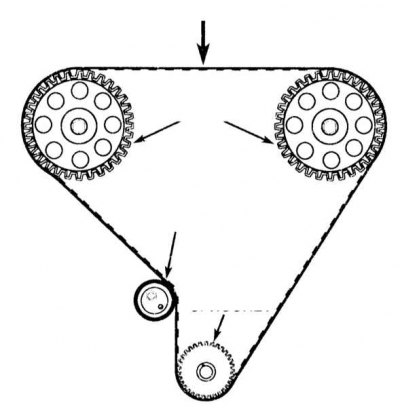
6. Tightly (with a force of about 10 kgf) press the belt on the section exactly in the middle between the camshaft gears and measure the amount of its deflection. The required value should be between 13 and 15 mm.
7. If the deflection value is within the permissible range, the belt tension force can be considered adjusted correctly, otherwise, the tensioner lock nut should be loosened and the appropriate adjustment should be made (see below).
Note: When adjusting the belt tension, it would be a good idea to have an assistant help you.
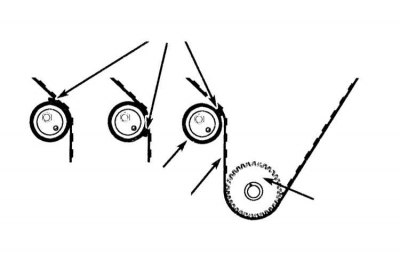
8. Insert the blade of a 0.35 mm thick feeler gauge into the gap between the belt and the tensioner roller in accordance with the diagram shown in the illustration - to pull the feeler gauge under the belt, slowly turn the crankshaft clockwise.
9. While pressing the tensioner firmly against the feeler gauge blade using a bar wrench, tighten the lock nut.
10. After turning the crankshaft, release the feeler gauge blade from under the belt, then turn the shaft further by two full revolutions, finally returning it to the TDC position at the end of the compression stroke.
11. Make sure that the belt tension is adjusted correctly.
Note: If the required tension force cannot be achieved with a used belt, it should be replaced.
12. Installation of the remaining components is carried out in the reverse order of their dismantling.