


2. Remove the rear wheels.
3. Disconnect the handbrake cable first from the bracket, then from the caliper lever.
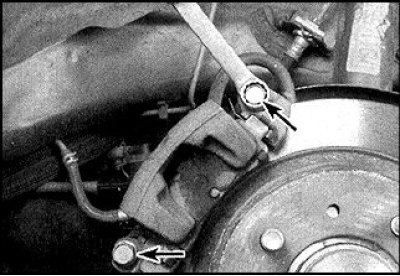
4. Turn out the caliper pins.
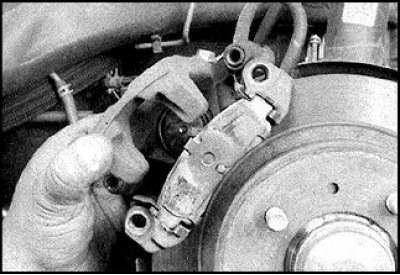
5. Remove the caliper body.
6. After disassembling the caliper, do not press the brake pedal.
7. Secure the caliper so that the hose is not stretched.
8. Remember the orientation of the side and anti-noise pads on the pads (anti-noise pads are provided on some vehicles and are located on the upper and lower ends of the pads).
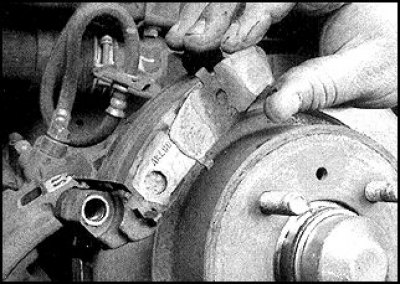
9. Remove the pads.
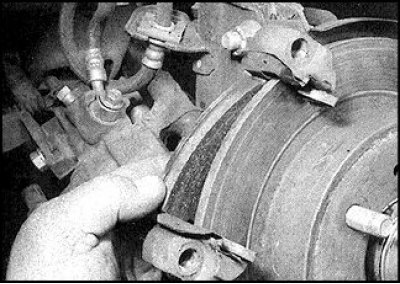
10. Remove the pads.
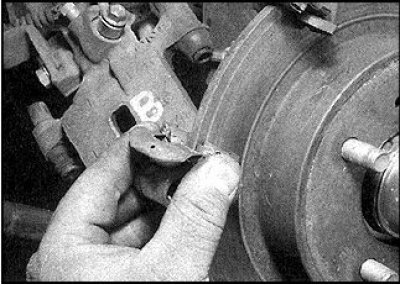
11. Remove the spring clips.
12. Check the thickness of the friction linings.
13. If the thickness of at least one pad is less than the norm, or the pads are heavily contaminated, then replace all pads in a set on one axle.
14. Find and eliminate the cause of contamination.
15. It is prohibited to rearrange the pads to compensate for wear.
16. If the condition of the pads is satisfactory, clean them, removing any ingrained dirt and large particles.
17. Clean the pad areas in the caliper.
18. Before assembly, check the freedom of movement of the pins in the bracket and support, as well as the integrity of the rubber boots.
19. Check the condition of the piston seals, the presence of corrosion on the piston and signs of leakage.
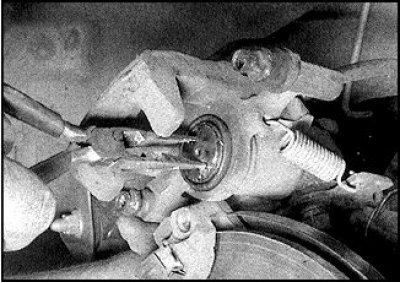
20. If the pads are to be changed, the piston should be pressed into the cylinder by turning the piston clockwise with round-nose pliers while simultaneously pressing it into the cylinder.
21. When moving the piston, monitor the fluid level; excess fluid above the MAX mark on the tank should be removed with a rubber bulb or syringe.
22. Lightly lubricate the brake pad plates, linings and spring clips with a special anti-noise lubricant.
23. Please note that new pads are supplied with an anti-noise coating and do not require lubrication.
24. Install the noise-deadening brackets, pads and linings in their original places (brackets and pads are provided on some vehicles).
25. Install the caliper body. The protrusion on the back of the pads should fit into the piston recess.
26. If necessary, tighten the piston further.
27. Lubricate the lower caliper pin with a locking compound, screw the pins in and tighten to the specified torque.
28. Check the freedom of movement of the caliper using your fingers.
29. Attach the handbrake cable in the reverse order of removal, install the cable bracket and spring clip (if provided). The protrusion on the bracket should fit into the recess on the caliper body.
30. Repeat the above steps for the brake of the other rear wheel.
31. Adjust the handbrake.
32. Press the brake pedal several times.
33. Install the wheels, lower the car.
34. Check the fluid level.
35. Check the operation of the brakes before leaving.