


Table of contents: Installation ↓ Post-installation check ↓
Attention:
- Do not spill brake fluid on painted areas; it may cause damage to the paintwork. If brake fluid spills on painted areas, wipe it off immediately and rinse with water.
- Do not bend, twist or pull brake hoses or pipes.
- To prevent dust and other foreign particles from entering the brake fluid, plug the open ends of brake hoses and pipes when disconnecting them.
1. Drain the brake fluid. See section "Draining and filling".
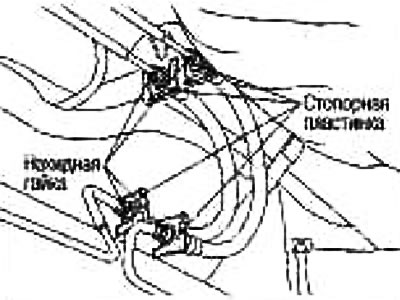
2. Using a spanner, disconnect the brake pipe from the hose.
3. Remove the lock plate and remove the brake hose from the vehicle.
Installation
Attention:
- Fill with fresh Nissan Genuine Brake Fluid or "DOT 3" or "DOT 4" (US FMVSS No.116).
- Do not mix brake fluid of different brands ("DOT 3", "DOT 4").
- Do not reuse drained brake fluid.
1. Connect the brake hose to the brake pipe, tighten the union nuts by hand as much as possible.
2. Secure the brake hose with the lock plate, then use the spanner wrench to tighten the union nuts to the specified torque.
Tightening torque: 16.2 Nm (1.7 kg·m)
3. Fill with fresh brake fluid. See section "Draining and filling".
4. Remove air. See section "Bleeding the brake system".
Post-installation check
Caution: If there is a leak at the fittings, tighten or replace damaged components if necessary.
1. Check that there is no fluid leaking from the brake pipes and hoses and at the joints, that they do not touch other components, that the connections are not loose, and also make sure that the hoses and pipes are not damaged, twisted or deformed.
2. Check for fluid leaks from components by depressing the brake pedal for approximately 5 seconds with the engine running.