


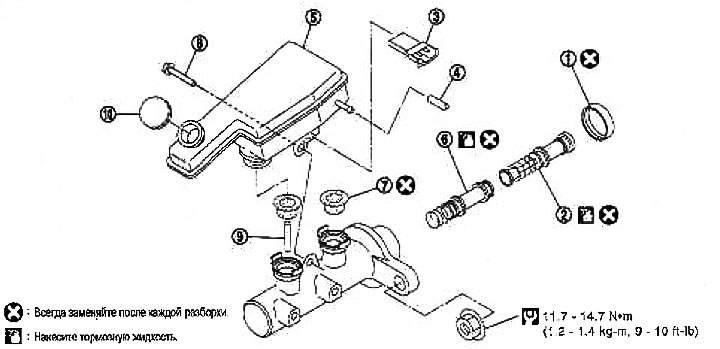
1. Locking cap; 2. Primary piston assembly; 3. Brake fluid level sensor connector; 4. Clutch reservoir hose (on models with manual transmission); 5. Tank; 6. Secondary piston assembly; 7. Rubber bushing; 8. Screw; 9. Piston stopper; 10. Tank lid
Disassembly
Caution: Only remove the master cylinder reservoir if absolutely necessary.
1. Using a screwdriver, bend the tabs of the locking cap outward as shown in the figure and remove the locking cap from the master cylinder.
2. Remove the tank mounting screw from the cylinder body.
3. Remove the tank and take out the rubber bushing from the cylinder body.
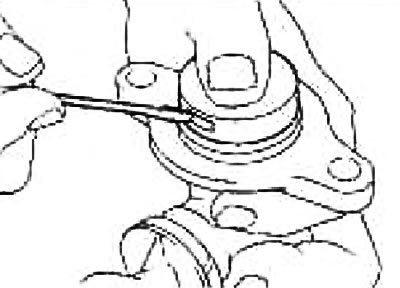
4. Using a flat-blade screwdriver, push in the piston as shown in the figure. Remove the piston stopper from the cylinder body.
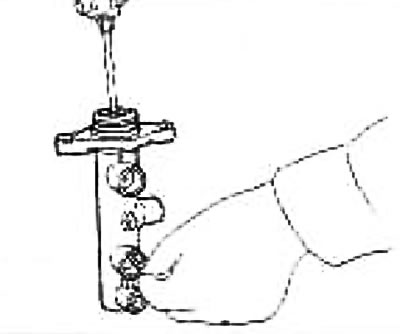
Caution: Do not damage the inner walls of the cylinder.
5. Carefully, without distorting it, to avoid damaging the cylinder walls, remove the primary piston assembly.
6. Lightly tap the flange on a wooden block and carefully, without distorting it, to avoid damaging the cylinder walls, remove the secondary piston assembly.

Checking after disassembly
Check the inside walls of the master cylinder for damage, wear, corrosion, and pitting. Replace the cylinder if necessary.
Assembly
Attention:
- When cleaning and assembling, do not use mineral oils such as kerosene or gasoline.
- Make sure there are no foreign particles on the inner walls, piston and cylinder seal. Do not damage the components with special tools during assembly.
- Do not drop components. Do not put down components that have fallen.
1. Apply brake fluid to the inner walls of the cylinder body and the contact surface of the piston assembly.
2. Insert the secondary piston assembly into the cylinder body first, then the primary piston assembly.
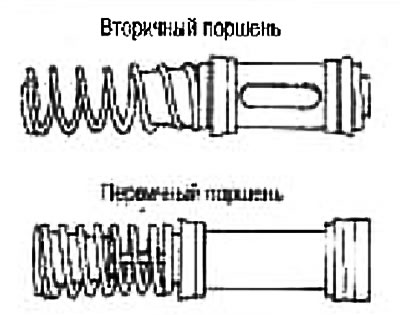
Attention:
- Do not reuse primary and secondary pistons.
- Observe the direction of installation of the piston cuff. Insert it without distortions so that it does not touch the inner walls of the cylinder.
- Always replace the complete internal parts kit.
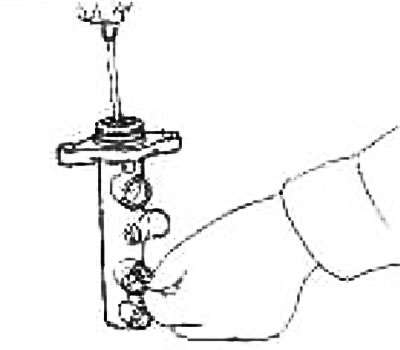
3. Visually check the installation direction of the slot in the secondary piston through the tank hole in the cylinder body and insert the piston stopper.
4. Place the locking cap on the piston. Press the locking cap until its tabs are fully engaged in the groove on the cylinder body.
Caution: Do not reuse the retaining cap.
5. Apply brake fluid to the rubber bushing and press it into the master cylinder body.
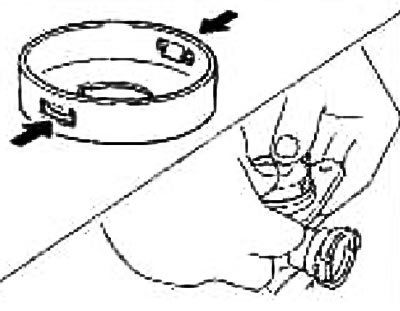
Caution: Do not reuse the rubber bushing.
6. Install the tank and screw the mounting screw into the cylinder body.