


Attention! The coolant should be replaced on a cold engine.
Note: For more information on the cooling system, see Chapter Engine cooling, heating, ventilation and air conditioning systems.
1. Remove the radiator cap and disconnect the lower radiator hose. Try to avoid getting coolant on the drive belts.
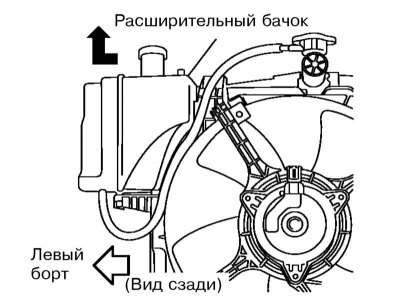
2. Remove the expansion tank and completely drain the coolant. To do this, remove the relay mounting block, disconnect the expansion tank from the fan casing and pull the tank upwards with force applied towards the left side of the car.
3. Check the coolant for dirt and rust particles, and pay attention to the color of the coolant. Clean the cooling system if necessary.
4. Install the expansion tank and connect the lower radiator hose.
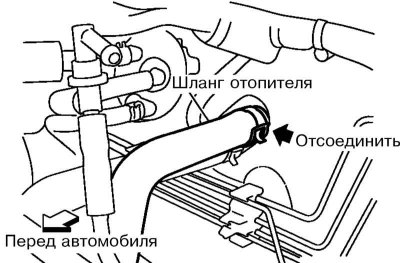
5. Disconnect the heater hose and hold the end of the hose at the same height.
6. Slowly fill the radiator and expansion tank with coolant until it starts to flow out of the heater hose. Then reconnect the heater hose and completely fill the system.
7. Close the radiator cap and warm up the engine until the thermostat opens. This can be determined by the heating of the upper radiator hose.
8. Turn off the engine and let it cool down to a temperature of 50 degrees. Remove the radiator cap, check the coolant level and correct it if necessary (see section Checking fluid levels, leak monitoring), bringing it to the "MAX" mark on the expansion tank.
9. Check the cooling system for leaks. Run the engine for 30 seconds at 1000 rpm, then gradually increase the speed to 3000 rpm. Repeat this procedure 3 times and make sure that the sound of running water is not heard from the heater radiator.
10. If such a sound occurs, repeat the procedure starting from step 5.