


Table of contents: Driving a car with a manual…↓ Driving a car with an automatic…↓
Driving a car with a manual transmission
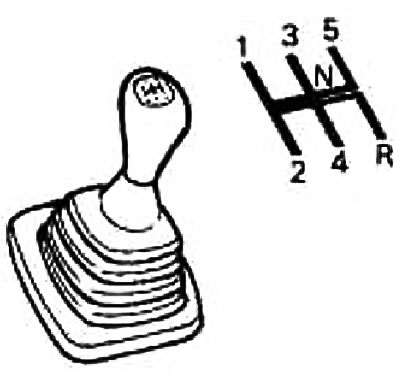
Moving the car from a standstill
1. Fully depress the clutch pedal and move the gearshift lever to position 1 or R.
2. Slowly depress the accelerator pedal while releasing the clutch pedal and parking brake handle.
Shifting on a 5-speed gearbox
When changing gears, you need to fully depress the clutch pedal, shift to the desired gear and smoothly release the clutch pedal.
For smooth gear shifting, it is important to fully depress the clutch before selecting a gear. If the clutch is not fully released during gear shifting, a grinding noise may be heard from the gears. This could damage the gearbox.
Start moving in 1st gear, then shift sequentially to 2nd, 3rd, 4th and 5th gear depending on your speed.
To move in reverse, you need to stop the car, put the gear shift lever in neutral position N and then in position R.
If you have difficulty shifting into reverse or first gear, do the following: Set the gearshift lever to neutral and depress the clutch pedal. Wait a few seconds, fully depress the clutch pedal again and engage reverse or first gear.
Driving a car with an automatic transmission
Driving Instructions
It is prohibited to move the selector lever to position P or R until the vehicle has come to a complete stop.
Start the engine only when the selector lever is in position P. In other selector lever positions, starting the engine is not possible. If the engine starts in other selector lever positions, you should immediately contact a service station to check and repair the car.
Do not press the accelerator pedal when shifting from P or N to R, D, 2 or 1.
When stopping on an incline, do not try to keep the car from rolling by pressing the accelerator pedal. To hold the car, to avoid overheating the automatic transmission, you need to use the service brake system.
If a long stop is expected, move the selector lever to position P and apply the parking brake.
Before the selector lever is moved from position N to any other driving position, the engine must continue to run in idle mode.
Moving the car from a standstill
If the engine is running, before shifting the selector lever from position P to positions R, D, 2 or 1:
- 1 Press the service brake pedal and the button on the selector lever and move the selector to the drive position.
- 2. Release the parking brake, brake pedal and, smoothly pressing the accelerator pedal, start moving.
The automatic transmission mechanism makes it necessary to press the brake pedal before selecting any range for driving with the ignition on
To move the selector lever:
 Press the button while pressing the brake pedal.
 Press the button to move the selector lever.
 The selector lever moves without pressing the brake pedal,
Switching Ranges
The button is pressed to move the selector lever to positions P, R or from range 2 to range 1. All other positions are selected without pressing the button.
|
Right hand drive models
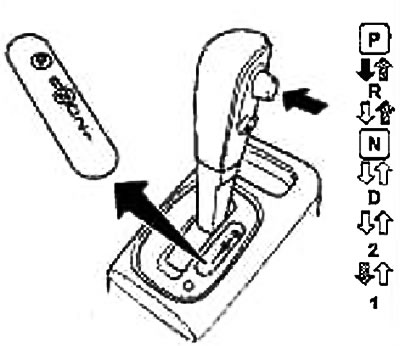 |
Left hand drive models
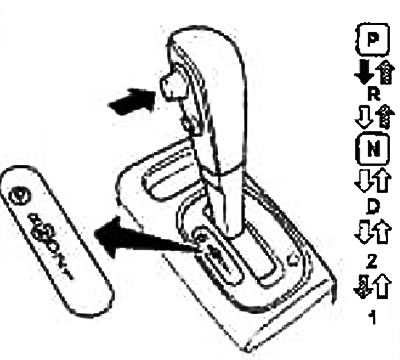 |
R (parking)
The selector lever must be set to this position when parking and when starting the engine. Always bring the vehicle to a complete stop before selecting position P. For added safety, press the brake pedal before selecting position P. Apply the parking brake at the same time as selecting position P. When stopping on a slope, first press the brake pedal, then apply the parking brake, and only then shift the selector lever to position R.
R (reverse)
Note: The selector lever can only be moved to position R after the vehicle has come to a complete stop.
N (neutral range)
In this selector position, the engine is disconnected from the drive wheels. This selector position can be used when starting the engine. If the engine stalls while driving, you can switch the selector lever to position N and try to start the engine again.
D (movement)
This selector position is intended for use under normal vehicle driving conditions (forward).
2 (second gear)
The range is used when driving the car uphill and for effective engine braking on descents.
1 (low gear)
Use range 1 when climbing steep hills at low speeds, or when driving slowly in deep snow, sand, or muddy conditions. Range 1 also provides maximum engine braking on steep descents.
Recommended maximum speed
If it is obvious that the engine cannot handle the proposed load or the car needs to accelerate, then shift to a lower gear.
Do not exceed the maximum recommended driving speed for each range (see below). When driving on level road surfaces, use the highest gear. Observe posted speed limits and select a driving speed appropriate to road conditions. Do not increase engine speed when downshifting, as this may damage the engine or cause loss of control.
Recommended maximum speed:
- 1st range - 55 km/h
- 2nd range - 100 km/h
Forced downshifting of the transmission when the accelerator pedal is pressed sharply in the d range (driving).
To quickly overtake or climb a steep hill, press the accelerator pedal all the way down. The gearbox will automatically shift to second or first gear (depending on the current speed of the vehicle).
Overdrive Lock Button
|
Right hand drive models
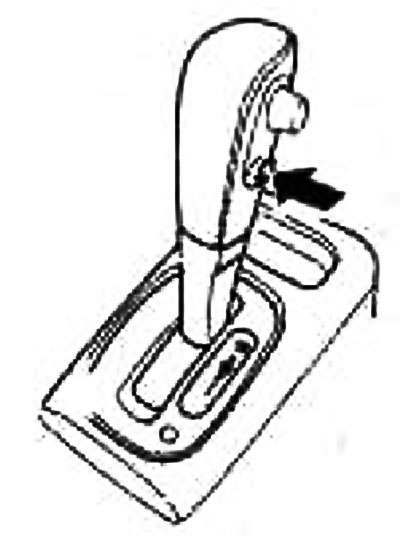 |
Left hand drive models
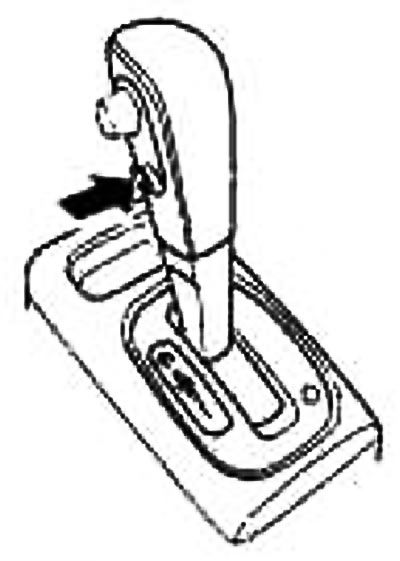 |
"ON" position
Press the button Under normal driving conditions, with the selector lever in position D The transmission shifts into an upshift and the vehicle accelerates.
The upshift gear will not engage until the engine has reached normal operating temperature.
"OFF" position
Used on uphill and downhill gradients where engine braking may be useful. Press the overdrive lock button until the button comes out of the depressed position. When overdrive is disengaged, the indicator on the instrument panel lights up.
(Data posted on the website: www.NissanBook.ru)
When driving at low speeds or when climbing a gentle incline, the transmission may cycle from third to upshift and back. You may feel these shifts as small jolts. In such cases, you should press the button and lock the upshift (the button should come out of the recessed position).
After changing the vehicle's driving conditions, press the upshift button and move it to the on position (the button should be recessed). After switching to overdrive, the indicator goes out.
It is not recommended to drive at high speed for a long time with the overdrive lock engaged. Remember that this increases fuel consumption.
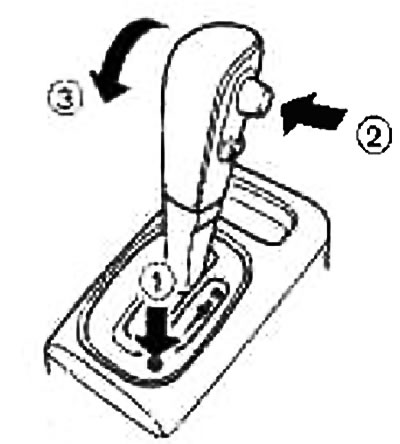
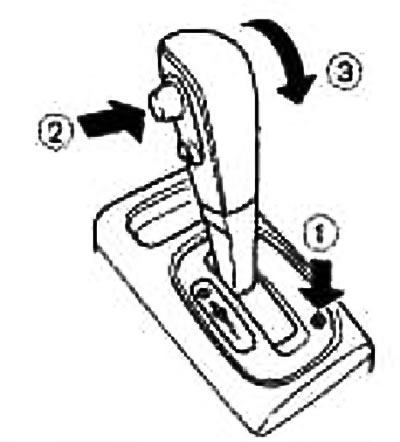
Removal the selector lever lock
If the battery is discharged, the selector lever cannot be moved from the P position even if the brake pedal is depressed and the ignition switch is turned to the ON position.
To move the selector lever, press the release button ①, press the button ② on the selector lever and move the lever to the N position.
For safety, keep the brake pedal depressed.
If you had to resort to using the button to remove the lock, contact a service station as soon as possible to check the system.
|
Right hand drive models
 |
Left hand drive models
 |
Automatic transmission emergency mode
When emergency mode is activated, the gearbox is locked in third gear.
The automatic transmission may go into emergency mode if the vehicle is driven under very severe conditions, such as intense wheel spin alternating with emergency braking. This happens even if the automatic transmission electrical system is fully functional. In this case, proceed as follows. Turn the ignition key to the OFF position and wait 3 seconds. Then turn the ignition key to the ON position again.
The automatic transmission should return to normal operation. If the automatic transmission remains in emergency mode, contact a service station for inspection and repair.