


The clutch consists of a pressure and driven disc, as well as a hydraulic drive with a master and slave cylinder.
Clutch components
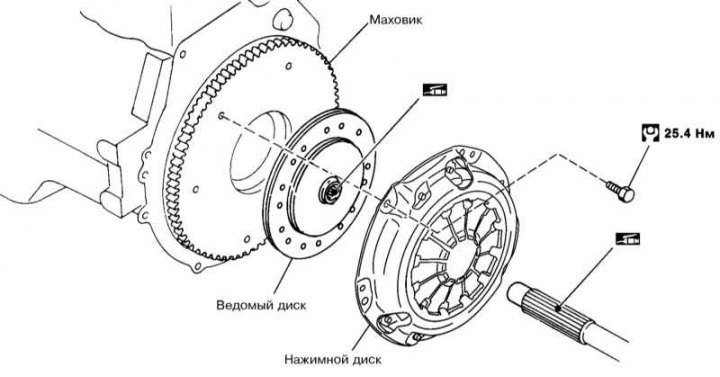
The pressure plate is bolted to the flywheel, which is connected to the engine crankshaft. Between the pressure plate and the flywheel is a driven disk, which is pressed against the flywheel by the thrust bearing of the slave cylinder. The driven disk is connected to the primary shaft of the manual transmission via a splined connection.
When the clutch pedal is depressed, the brake fluid from the common reservoir is transferred under pressure through the clutch master cylinder to the slave cylinder (CSC). The pressure bearing of the slave cylinder acts on the pressure plate. In this case, the driven disk is moved away from the flywheel and the power connection between the engine and the manual transmission is interrupted. In the released state, the pressure spring presses the bearing against the diaphragm spring of the pressure plate. This reduces wear on the clutch pressure bearing, since it does not accelerate to the engine speed when engaged. No adjustment of the clutch drive is required.
(Data posted on the website: nissanbook)
Each time the clutch is engaged and disengaged, the friction linings of the driven disk wear out as a result of the force applied. The driven disk is a wearing part, but its average service life is quite long and depends mainly on the engine load and driving style.