


| Component | Location of the adjusting bolt and method of tensioning the belt |
| Drive belt | Adjusting bolt on the tension pulley |
Attention:
- When replacing the belt with a new one, change it to the "new belt" value to compensate for the insufficient fit to the pulley grooves.
- When the tension of the belt being put on exceeds the limit, adjust it to the value of "after adjustment".
- When installing the belt, make sure it is seated correctly in the pulley groove.
- Do not allow engine oil or coolant to come into contact with the belt.
- Do not twist or bend the belt excessively.
1. Remove the protective cover from the front right fender. See chapter Body.
2. Loosen the tensioner pulley lock nut (A) from the tightening position with the required torque by 45°
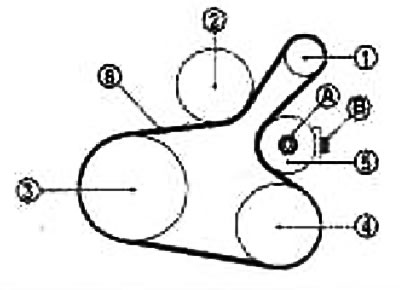
1. Generator; 2. Water pump; 3. Crankshaft pulley; 4. Air conditioning compressor (on models with air conditioning); Tension pulley (on models without air conditioning); 5. Tension pulley; 6. Drive belt
Attention:
- If the lock nut is loosened excessively, the tension pulley will tilt and fine adjustment of the tension will be impossible. Do not loosen the lock nut excessively (more than 45°).
- Place an alignment mark on the lock nut (A) and check the rotation angle with a protractor. Avoid eyeballing without tools.
3. Adjust the belt tension by turning the adjusting bolt (B).
See the section "Checking Drive Belts".
Attention:
- When checking the belt immediately after installation, first adjust it to the standard value. Then, after turning the crankshaft two revolutions or more, re-adjust the deflection to the standard value and eliminate the variation in the amount of belt deflection between pulleys.
- When adjusting the tension, the lock nut must be in position 2. If the tension is adjusted when the lock nut is loosened more than necessary, the tension pulley will tilt and it will be impossible to make precise tension adjustments.
4. Tighten the lock nut (A)
Tightening torque: 34.8 N·m (3.5 kg·m)