


Note: You will need a puller to perform the following procedures (for removing the crankshaft gear), micrometer and plunger type dial gauge.
Removal
1. With the engine removed from the vehicle, remove the timing belt, oil pan, oil pump oil intake, oil pump, flywheel and rear oil seal holder.
2. Remove the spark plugs from the engine.
3. Loosen the mounting nuts and remove the connecting rod lower head caps, stacking them in the order they were installed on the engine. Carefully push the connecting rod and piston assemblies up in the cylinders, without reaching the upper limit of the piston stroke.
Note: Check the connecting rods and connecting rod bearing caps for identification marks.
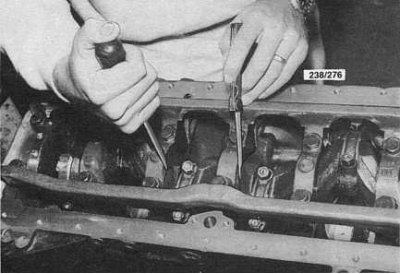
4. Using a blade-type feeler gauge (on the fourth main bearing - see accompanying illustration), or use a dial gauge to check the axial play of the crankshaft (fix the measuring device on the front wall of the block with the plunger towards the end of the shaft).
5. If using a dial gauge, push the crankshaft back as far as it will go and reset the gauge to zero.
6. Push the shaft forward until it stops and read the dial indicator. If the working surfaces of the thrust central main bearing are in good condition, the measurement result should not exceed 0.30 mm.
7. Loosen the main bearing cap bolts in several stages, in the reverse order of tightening. The main bearing cap components are shown in the accompanying illustration. Note the location of the long bolts.
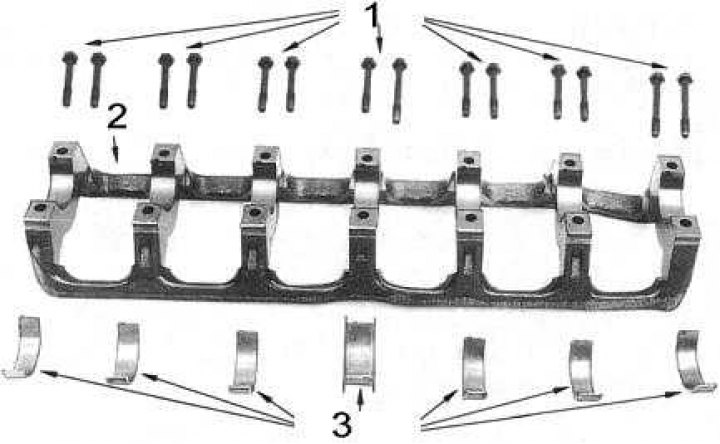
1 - bolts
2 - lid
3 - bearing shells
8. Before removing the crankshaft, you can measure the clearances in its main bearings using a calibrated plastic wire from the Plastigage kit:
- Wipe the bearing surfaces thoroughly with a clean, lint-free cloth;
- Place seven pieces of calibrated wire from the measuring kit along the shaft journals (slightly off axis);
- Install the common main bearing cap and tighten its mounting bolts in a diagonal order, moving from the center outward;
Note: Do not allow the shaft to rotate after placing the wire pieces on it.
- Loosen the bolts and carefully remove the cover, remove the lower bearing shells;
- By measuring the width of the flattened sections of calibrated wire using the scale on the packaging of the measuring kit, determine the clearances in the main bearings of the shaft;
- Where the wire is flattened more, the gap is smaller, and vice versa.
9. Carefully remove the crankshaft from the engine crankcase - try not to damage or drop the upper main bearing shells, especially if you do not plan to replace them.
10. If the liners are to be replaced, remove them from their seats in the engine crankcase.
Checking the status
1. Assess the condition and degree of wear of the main and connecting rod journals of the crankshaft, check them for taper and ovality. If necessary, resurface the journals to the nearest standard repair size.
Note: Even if only one of the journals is worn or damaged (main or connecting rod) all the others must also be sharpened (respectively main or connecting rod). In this case, new bearing shells of the appropriate repair size should be prepared.
2. If the nature of the wear does not allow the shaft journals to be restored by turning, the shaft should be replaced.
3. Check the condition of the thrust surfaces of the central bearing (see accompanying illustration). If deep cavities and grooves are detected, replace the bearing shells, which should normalize the axial clearance of the crankshaft.
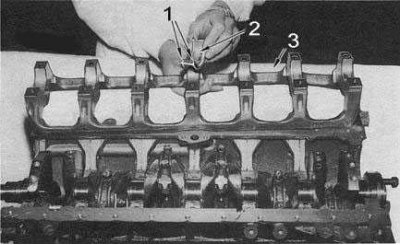
1 - built-in thrust plates
2 — thrust bearing shell
3 — main bearing cap
4. Even if the clearances in the main bearings are considered satisfactory, check the liners for scratches, scoring, cracks, cavities and other defects. If necessary, replace the defective liners (in pairs).
5. Place the crankshaft ends in V-shaped blocks and use a dial gauge to measure the runout in the area of the central main bearing. If the result exceeds 0.10 mm, the shaft should be replaced.
Installation
Installation is carried out in reverse order.
1. Check the patency of all oil flows and the cleanliness of all shaft journals.
2. Wipe down all bearing shells again and lubricate them with clean engine oil. Place the shells correctly in their beds.
Note: When installing the upper main bearing shells, make sure that the oil holes in them are aligned with the corresponding holes in the bearing beds. The upper shells are distinguished by the presence of oil grooves.
3. Place the crankshaft into the cylinder block, fitting the connecting rod journals into the lower heads of their connecting rods.
4. Place the lower main bearing shells into their beds in the cover. Make sure that the bearing tabs fit into the corresponding grooves in the cover.
5. Lubricate the lower main bearing shells with clean engine oil and install the main bearing cap assembly onto the engine.
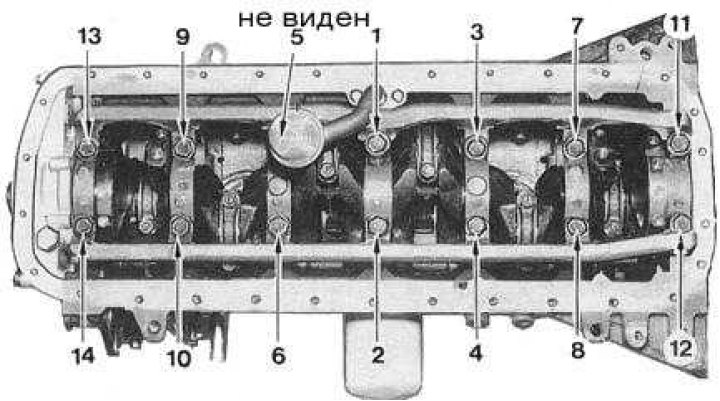
6. Screw in the cover mounting bolts and tighten them in several stages to a force of 46÷52 Nm in the order shown in the accompanying illustration.
Note: Make sure that the long bolts are screwed into their original holes.
7. Check the freedom of rotation of the crankshaft. Measure the axial play of the shaft.
8. Replace the rear crankshaft oil seal and install the holder on the block.
9. Install the connecting rod lower heads onto their journals. Lubricate the connecting rod bearing shells with clean engine oil and install the bearing caps onto the connecting rod lower heads. Make sure that the identification marks on the connecting rods and their caps match. Tighten the connecting rod bearing cap fasteners to the required torque.
10. Install all components removed during disassembly.