


Removal and disassembly
1. Remove the timing belt.
2. Remove the timing gear and rear guide plate from the crankshaft.
Note: To avoid damaging the oil pump/crankshaft oil seal when removing the pump, remove the key from the drive pinion journal.
3. Loosen the bolts securing the oil pump to the cylinder block. Tap the bottom of the inner surface of the pump to remove it from the crankshaft journal. Discard the gasket.
Note: The internal gear of the oil pump is driven by two flats machined into the crankshaft.
4. Loosen the mounting screws and remove the rear cover of the oil pump (the components of the oil pump are shown in the accompanying illustration).
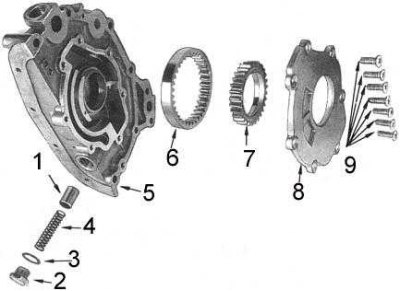
1 - plunger; 2 - cork; 3 - gasket; 4 - spring; 5 - body; 6 - external gear; 7 - internal gear; 8 - back cover; 9 - screws
5. Carefully, remembering their installation positions, remove the internal and external gears of the oil pump from the pump housing.
6. Unscrew the plug of the pressure reducing valve, remove the spring seat, spring and plunger.
7. Carefully remove the crankshaft oil seal from the oil pump - use a special puller or a flat-head screwdriver. Discard the seal.
Checking the status
1. Wash all oil pump components thoroughly in a suitable solvent, then dry them.
2. Inspect the pump body and cover for signs of wear, deformation and other damage.
3. Inspect the plunger of the pressure reducing valve for defects.
4. Check the pressure reducing valve spring for damage and compare its performance characteristics (length and compression force) with the parameters of the new spring.
5. Using a blade-type feeler gauge, measure the clearance between the teeth of the inner and outer gears and the crescent-shaped spacer. If the clearance is outside the permissible limits (see size and adjustment tables at the end of the Manual), replace both gears.
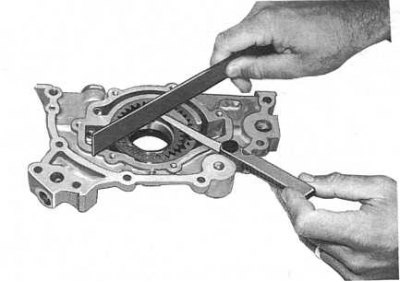
6. Using a feeler gauge and a flatness meter (steel ruler edge) check the clearances between the end surfaces of both gears and the pump cover (see accompanying illustration). If the measurement results go beyond the permissible limits (see size and adjustment tables at the end of the Manual) replace both gears and / or the pump housing.
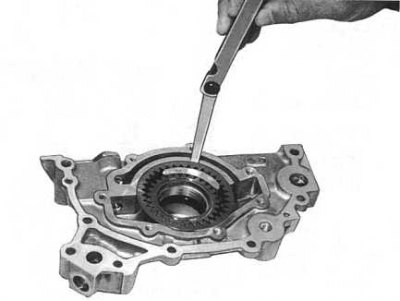
7. Measure the clearance between the outer gear and the pump housing wall (see accompanying illustration). Replace outer gear and/or housing if necessary.
8. Check the condition of the oil intake mesh filter. If it is blocked or damaged, clean or replace the mesh.
Assembly and installation
Assembly and installation of the pump are carried out in the reverse order of its dismantling.
1. Check the cleanliness of the gland seat, lightly lubricate the new gland with sealant around the perimeter. Place the gland in the seat flush with the end of the pump body (the components are shown in the accompanying illustration).
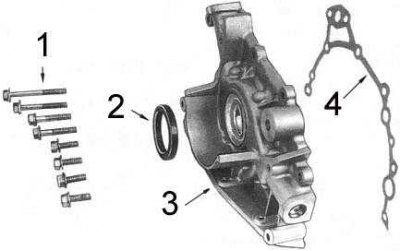
1 - bolts; 2 - oil seal; 3 - oil pump; 4 - gasket
2. Install the pressure reducing valve components into the pump assembly, tighten the plug with a force of 39÷69 Nm.
3. Install the external gear into the pump body (with a larger chamfer along the outer edge towards the rear cover of the pump).
4. Install the internal gear (with the grooved side facing the rear cover of the pump).
5. Lubricate the gears with engine oil and install the rear cover of the pump. Tighten the fastening screws with a force of 4÷5 Nm.
6. Apply sealant to both sides of the new pump gasket.
7. Lightly lubricate the seal lips and place the pump assembly on the crankshaft journal, ensuring that the internal gear flats engage correctly with the crankshaft.
8. Align the pump assembly and its gasket on the cylinder block and screw in the mounting bolts. Tighten the bolts to 9÷11.8 Nm.
9. Install the oil pan and oil intake assembly on the engine, fill the engine with the required amount of oil of the required grade.
10. Install the crankshaft gear, timing belt and vibration damper.
11. Start the engine, warm it up to normal operating temperature. Check for oil leaks, make any necessary corrections.