


AT in section
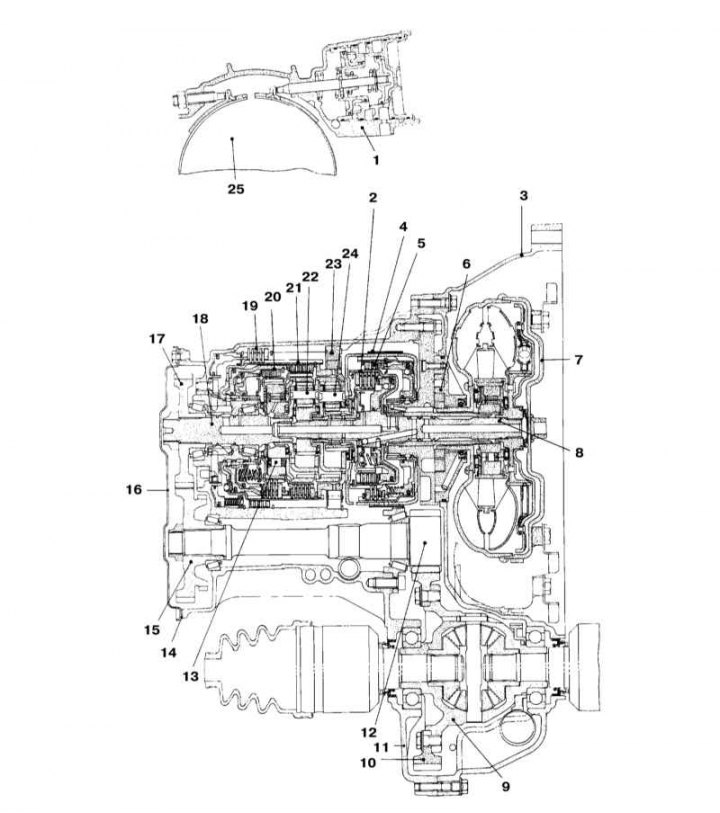
1 - Tape reinforcement piston; 2 - High gear clutch; 3 - Torque converter housing; 4 - Brake band; 5 - Reverse gear clutch; 6 - Oil pump; 7 - Torque converter; 8 - Input shaft; 9 - Differential gear; 10 - Main gear; 11 - Carter AT; 12 - Reduction gear; 13 - Freewheel clutch; 14 - Gasket; 15 - Intermediate gear; 16 - Side cover; 17 - Output gear; 18 - Output shaft; 19 - Low and reverse gear brake; 20 - Overrunning clutch; 21 - Forward Mode Clutch; 22 - Reverse planetary gear; 23 - Low gear single-way clutch; 24 - Planetary transmission of forward motion modes; 25 - Reverse clutch drum
4-speed AT (RE4F03B) is installed on models with 1.2 and 1.4 l engines.
When starting the movement, the AT acts as a regular clutch, and when the car is moving, it performs the work of shifting gears.
The main components of the AT are: torque converter (torque converter), planetary gearbox, hydraulic or electronic control units. To switch to another gear ratio in the planetary gearbox, hydraulically driven disc and band brakes and disc clutches are used.
The torque converter corresponds to the hydraulic clutch in its functions. Its task is to implement the clutch when starting the movement and changing gears. The torque converter is equipped with a locking clutch, which directly couples the engine to the AT.
AT control system diagram
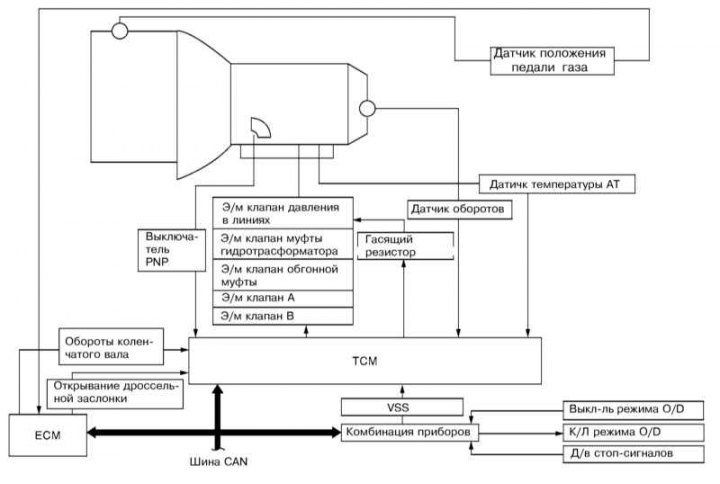
The automatic transmission control system is connected to the engine control system via the CAN bus and based on the analysis of data received from various information sensors (not necessarily directly related to the functioning of the transmission itself), selects the optimal mode of operation of the AT in terms of economy, smoothness of switching, etc. The AT has its own control unit (TCM). When a malfunction is detected, a corresponding code is written into the memory of the control unit (see Specifications).
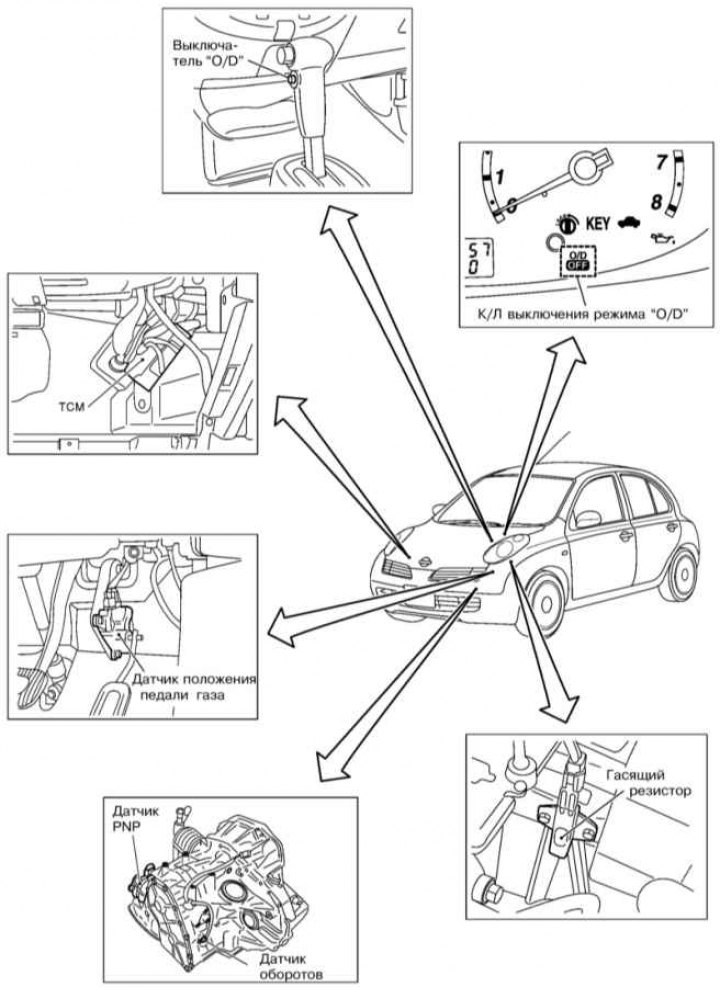
Location of AT control system components
The only AT maintenance procedures that must be performed on a regular basis are checking the level of its working fluid (ATF) and replacing the ATF. The order of performing these procedures is described in Sections Checking fluid levels, leak monitoring and Replacement of transmission oil AT and RKPP (respectively).
Thanks to the use of D/V modes "P" / "N" (pNP sensor) the engine can only be started when the AT selector lever is in the "P" or "N" position, which prevents accidental movement of the vehicle when attempting to start.
If the sensors used by the TCM fail, the AT switches to emergency mode. In this case, the car can only move forward in 4th gear. The electromagnetic gear shift valves are de-energized.
This Chapter provides only general information on the operation of the AT. More detailed information on the principles of operation and maintenance of the AT can be found in Manual 179 "Automatic Transmissions of Modern Passenger Cars" published by "ARUS".
Hydraulic lines diagram AT
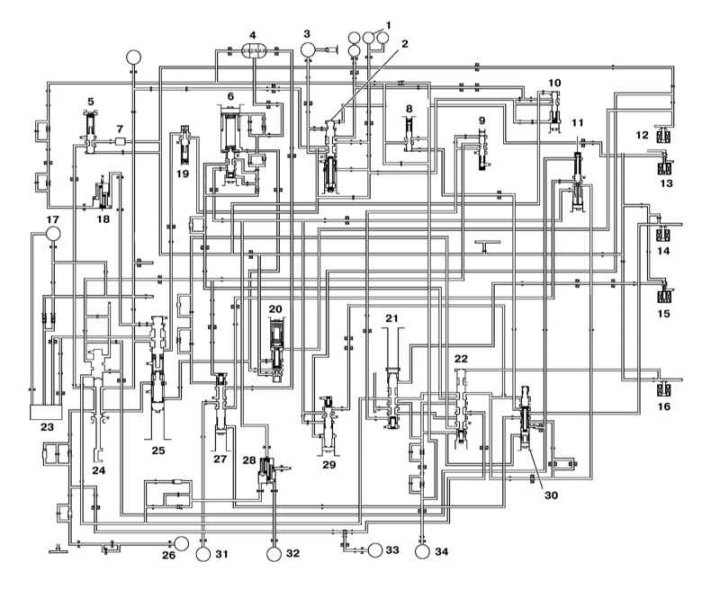
1 - Engaging the torque converter; 2 - Torque converter clutch check valve; 3 - Turning off the torque converter; 4 - Tape servo drive; 5 - Control valve; 6 - Valve and piston of accumulator of gears 1-2; 7 - Filter; 8 - 3-2 shift timing valve; 9 - 1st gear reduction valve; 10 - Oil cooler check valve; 11 - Overrunning clutch pressure reducing valve; 12 - Electromagnetic valve for pressure control in AT lines; 13 - Electromagnetic valve of the torque converter clutch; 14 - Overrunning clutch solenoid valve; 15 - Solenoid valve B; 16 - Solenoid valve switching A; 17 - Oil pump; 18 - Servo off battery; 19 - Torque converter bypass valve; 20 - Pressure modulation valve; 21 - Switch valve B; 22 - Switch valve A; 23 - Oil intake; 24 - Manual valve; 25 - Pressure regulating valve; 26 - Reverse gear clutch; 27 - Overrunning clutch control valve; 28 - Battery for modes "N" and "D"; 29 - Accumulator check valve; 30 - Spool control valve; 31 - Overrunning clutch; 32 - Forward Mode Clutch; 33 - 1st gear and reverse gear brake; 34 - High gear clutch
Gear shift mechanism design
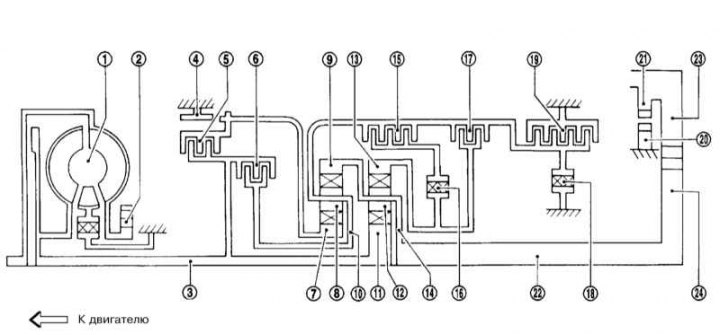
1 - Torque converter; 2 - Oil pump; 3 - Input shaft; 4 - Brake band; 5 - Reverse gear clutch; 6 - High gear clutch; 7/8 - Central/small gear for forward transmission; 9 - Forward motion transmission internal gear wheel; 10 - Planetary gear for forward motion transmission; 11/12 - Reverse gear center/small gear; 13 - Reverse gear internal engagement gear; 14 - Reverse planetary gear; 15 - Forward Clutch; 16 - Freewheel clutch; 17 - Overrunning clutch; 18 - Low gear single-way clutch; 19 - Low and reverse gear brake; 20 - Parking mode fuse; 21 - Parking mode gear; 22 - Output shaft; 23 - Intermediate gear; 24 - Output gear
(The source is indicated on the page NissanBook)
List of components involved in AT modes (component numbers correspond to illustration numbers)
Mode | 5 | 6 | 15 | 17 | Tape servo drive | 16 | 18 | 19 | Blocking | |||
| 2nd incl. | 3rd off. | 4th incl. | ||||||||||
| P | ||||||||||||
| R | O | O | ||||||||||
| N | ||||||||||||
| D*4 | 1 | O | *1 D | B | B | |||||||
| 2 | O | *1 A | O | B | ||||||||
| 3 | O | O | *1 A | *2 C | C | B | *1 O | |||||
| 4 | O | C | *3 C | C | O | O | ||||||
| 2 | 1 | O | O | B | B | |||||||
| 2 | O | O | O | B | ||||||||
| 1 | 1 | O | O | B | O | |||||||
| 2 | O | O | B | |||||||||
1 - Operates when the "O/D" mode switch is in the "OFF" position.
*2 - Oil pressure is applied simultaneously to the "2nd on" and "3rd off" sides of the belt reinforcement piston.
*3 — Oil pressure is applied to the "4th on" side under condition *2.
*4 — The AT will not shift to 4th gear when the O/D mode switch is in the OFF position.
A - Works when the throttle valve is open no more than 3/16, engine braking is activated.
B - Works under strong acceleration.
C - Works, but does not affect power transmission.
D - Works when the throttle valve is open no more than 3/16; does not affect power transmission.