


Table of contents: Signs of a problem with the brake…↓ Brake lines and hoses ↓ Checking the thickness of brake pads…↓ Checking and adjusting the brake and…↓ Checking the brake booster ↓ Checking the tightness of the vacuum…↓
Warning! Dust from lining wear that accumulates on brake components may contain asbestos, which is hazardous to health. Do not blow out this dust with compressed air or inhale it! Do not use gasoline-based solvents to remove dust.
Note: In addition to checking at specified intervals, the condition of the brake mechanisms should be checked each time the wheels are removed or if there are signs of a malfunction in the brake system. Checking the brake fluid level is described in Section Checking fluid levels, leak monitoring.
Signs of a problem with the brake system
Any of the following symptoms may indicate a potential brake system defect:
- When pressing the brake pedal while driving, the car "pulls" to one side;
- The brakes make scraping or squealing sounds when braking;
- The brake pedal has excessive travel;
- The brake pedal is pulsating (this is normal only when the ABS system is working);
- Brake fluid leaks are observed (usually visible on the inside of a tire or wheel)
If you notice any of these signs, have your brake system inspected immediately.
Brake lines and hoses
Note: The brake system uses mostly metal brake lines, with the exception of flexible, reinforced hoses at the wheels. Regular inspection of all these lines is very important.
1. Park the car on a level surface.
2. Jack up the vehicle and place it on stands, then remove the wheels. Checking the vacuum hoses is described in Section Checking the condition and replacing hoses and tubes in the engine compartment, localizing leaks.
3. Check all brake lines and hoses for cracks or abrasions in their outer coating, as well as leaks, bulges, and deformations. Check the brake hoses at the front and rear of the vehicle for signs of softening, cracks, deformation, or wear due to friction with other parts. Check all fittings for signs of leaks and make sure that all brake line fasteners are secure.
4. Bend the brake hose in both directions with your hands to check for damage. Do not twist the hoses.
5. Turn the steering wheel to the right and left until it stops. Make sure that the hoses do not touch the vehicle's structural elements.
6. If brake lines are found to be leaking fluid or damaged, the leaks should be repaired immediately. For a more detailed description of the brake system repair procedure, refer to Chapter Brake system.
Checking the thickness of brake pads and discs
1. Jack up the car and place it on supports, then remove the corresponding wheel.
Note: Experience shows that due to dirt on the side of the road, the brake pads on the right wheel wear out more than those on the left. Therefore, it makes sense to remove the front right wheel for inspection.
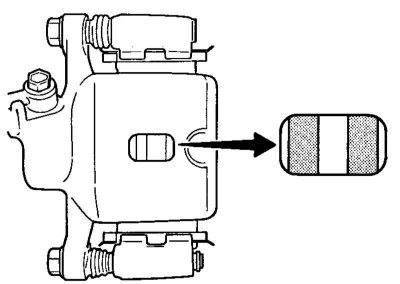
2. Measuring the thickness of the pad front disc brake is carried out through a special inspection window in the caliper. If the thickness of the pad is less than 2 mm, replace all the brake pads of both front wheel brake mechanisms.
Note: As a rule, 1 mm of brake pad friction lining wear corresponds to at least 1000 km of mileage under unfavorable operating conditions. Under normal conditions, the linings wear out much more slowly.
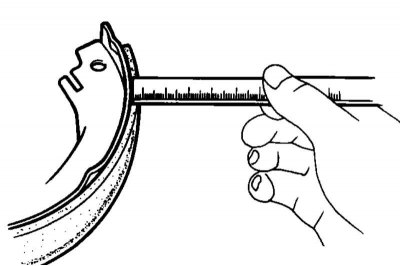
3. To check the thickness of the pad rear (drum) brakes jack up the car and inspect the pads from inside the disc. In doubtful cases, measure the thickness of the pad with the brake drum removed. If it is less than 1.5 mm replace all brake pads on both rear wheels.
4. Check the brake calipers for leaks. If leaks are found, repair the caliper immediately.
5. Visually inspect the brake discs and drums from the inside and outside for grooves, rust and cracks. Replace defective components.
6. Measure the thickness of the brake discs in several places using a micrometer or a special caliper. You can also measure the thickness of the brake disc with a regular caliper, placing a lining of a known size on each side (for example, two coins), and then subtract the thickness of the linings from the measured value.
7. Measure the inside diameter of the brake drums.
8. Compare the minimum result obtained in each case with the requirements Specifications. If the wear limit has been reached, be sure to replace both brake discs or drums. The brake disc/drum should also be replaced if there are large cracks or deep grooves on the working surface.
Checking and adjusting the brake and clutch pedals, as well as the parking brake lever
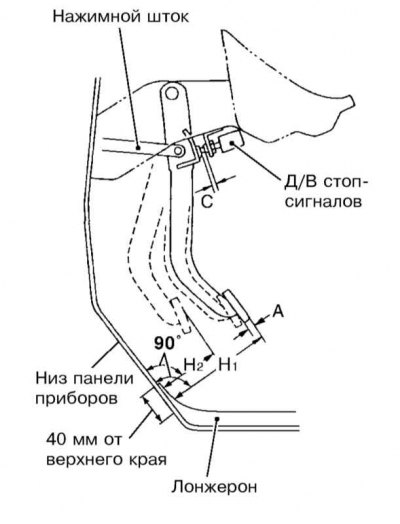
1. Measure the free play (A) and the height (H1) of the released brake pedal.
2. Make similar changes for the clutch pedal.
3. If the measured values do not meet the requirements Specifications, adjust the brake pedal as shown in the illustration. To do this, loosen the lock nut, screw in or unscrew the position sensor of the corresponding pedal and secure it with the lock nut.
4. Engage the parking brake by pulling the lever with a force of 196 N. You should hear 11-12 clicks. Otherwise, adjust the parking brake as described below.
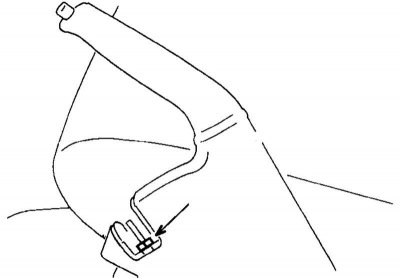
5. Insert a socket wrench into the gap in the parking brake lever and loosen the nut to completely loosen the parking brake cable. Release the parking brake lever.
6. Press the service brake pedal 2-3 times to select the brake pad clearance.
7. Rotate the rear wheels to ensure they move smoothly.
8. Pull the parking brake actuator lever to expose the adjusting nut and adjust the parking brake by turning it.
[For more information, see the website NissanBook]
Note: Once the nut has been given away, it cannot be reused.
9. After applying the parking brake 3-4 times with a force of 196 N, make sure that it is adjusted correctly. Then, with the parking brake released, make sure that the rear wheels move smoothly.
Checking the brake booster
1. With the engine off, press the brake pedal several times; with each press, its travel should decrease.
2. With the brake pedal depressed, start the engine – the pedal should move down.
3. Keep the brake pedal depressed and turn off the engine. If the pedal travel does not change after holding it for 30 seconds, the vacuum booster is OK.
4. If one of the above checks is not satisfactory, repair or replace the vacuum booster (see Chapter Brake system).
Checking the tightness of the vacuum booster check valve
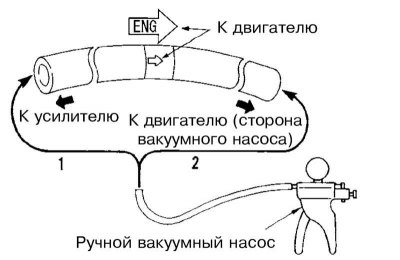
1. The test is carried out by connecting a hand vacuum pump to different sides of the check valve and creating a vacuum in it.
2. When connecting the pump from the vacuum booster side (1) and creating a vacuum 66.7 kPa, it can decrease by 1.3 kPa in 15 seconds.
3. When connecting the pump from the engine side (2), a vacuum should not occur.