


General diagnostics
1. If a fault occurs in the fuel injection/ignition system, first check that all system connection connectors are securely connected and not corroded.
2. Then check to see if poor engine maintenance is the cause of the problem; i.e., check that the air filter element is not clogged, that the spark plugs are in good condition and have the correct spark gap, that the engine valve clearances are correctly adjusted and that the compression pressure in the cylinders corresponds to the required value.
3. Also check that the ignition timing is set correctly and that the emission control systems are working properly. See subsection 7.7.1 andsubsection 6.4 for more detailed information.
4. If these tests do not help locate the source of the fault, a quick check of the fuel injection/ignition system circuits can be performed by setting the ECM to self-diagnostic mode "2".
5. In mode "2" the electronic control unit will display the fault code stored in its memory by turning on the warning light on the instrument panel or the red LED on the right side of the control unit.
6. Records of faults detected by the electronic control unit are stored in its memory until the starter is turned on 50 times.
7. If the fault is not detected again within this period of time, the fault record will be erased from memory.
8. Malfunction records can be erased from the memory of the electronic control unit by switching it to self-diagnostic mode "2" and then switching it back to mode "1" or by disconnecting the battery for more than 24 hours.
Setting self-diagnostic modes
1. Remove the fuse box cover to gain access to the diagnostic connector, which is mounted on the bottom of the fuse box.
2. Turn the ignition key to the "ON" position, but do not start the engine. The engine control unit is now in self-diagnosis mode "1".
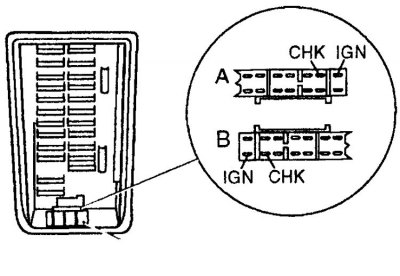
3. Using a piece of wire, connect the "IGN" terminal of the diagnostic connector and the "CHK" terminal.
4. Keep the terminals connected for more than 2 seconds, then disconnect the wire. The engine control unit is now in self-diagnosis mode "2".
5. In mode "2" the electronic control unit will display the fault code recorded in its memory.
Caution: If codes 11 and 21 are displayed simultaneously, check the crankshaft angle sensor circuit before checking the rest of the ignition system.
6. On models with a catalytic converter, if the ECU is set to mode "2", when the engine is started, the ECU automatically enters the exhaust gas sensor test mode. In this mode, the indicator light on the instrument cluster and the red LED indicate the state of the exhaust gas. When the indicator light and LED are on, it means the exhaust gas is low in CO, and when they are off, it means the exhaust gas is saturated with CO.
7. To check the sensor, set the electronic control unit to self-diagnostic mode "2", start the engine and warm it up to normal operating temperature.
8. After the engine has warmed up, increase the engine speed to approximately 2000 rpm and hold that speed for approximately 2 minutes, watching the indicator light on the instrument panel or the LED on the ECU.
9. If the exhaust gas sensor is working properly, the indicator light/LED should flash at least 5 times every 10 seconds.
10. After completing all checks, exit self-diagnosis mode "2".
11. If you have not started the engine, you can exit self-diagnosis mode "2" by connecting the "IGN" and "SNK" terminals of the diagnostic connector again for more than 2 seconds.
12. If the engine is running, exit self-diagnosis mode "2" by turning the ignition key to the "OFF" position and disconnecting the negative battery cable.
The original is posted on the portal NissanBook
13. If you need to perform a more detailed check of the fuel injection/ignition system, contact specialists. The auto repair shop should have an electronic diagnostic device that connects to the diagnostic connector and allows you to perform a complete check of all system elements.
Adjustment
On models without a catalytic converter, you can adjust the engine idle speed and fuel mixture composition (cO level in exhaust gases). On models with a catalytic converter, only the engine idle speed can be adjusted.
Error codes
| Code | Faulty chain |
| 11 | Crankshaft Angle Sensor Circuit |
| 12 | Air Flow Sensor Circuit |
| 13 | Coolant Temperature Sensor Circuit |
| 21 | Ignition signal circuit |
| 34 | Fuel Knock Sensor Circuit |
| 43 | Throttle Potentiometer Circuit |
| 55 | All circuits are working properly |