


Note: The following are procedures for checking for fluid and lubricant leaks.
1. Before starting the engine, check the oil and engine fluid levels. If insufficient, top up to the required level.
2. Check for fuel leaks as follows:
- Turn the ignition switch to the "ON" position (without starting the engine). After pressure has been created in the fuel lines, check for fuel leaks at the connections.
- Start the engine. Increase the crankshaft speed and check again for fuel leaks in the connections.
3. Let the engine run to check for any persistent noise or vibration.
Note: If the hydraulic pressure inside the chain tensioner drops after removal/installation, the slack of the tensioner shoe may cause a rattling noise all the time and immediately after starting the engine. However, this does not indicate a malfunction. The noise will stop after the pressure is built up.
4. Warm up the engine thoroughly to ensure there are no fuel or engine fluid leaks (including engine oil and coolant).
5. Remove air by bleeding from the pipelines and hoses of the hydraulic systems that were disconnected (for example, engine cooling systems).
6. After the engine has cooled down, check the engine oil/fluid levels again. If necessary, top up to the required level.
Checking the oil groove of the intake camshaft sprocket
Attention.
- Perform this test only if the CONSULT-III scanner detects the P0011 fault code as a result of self-diagnosis.
- To avoid scalding from splashing engine oil, check only on a cold engine.
1. Check the engine oil level.
2. Perform the following procedure to prevent the engine from starting unexpectedly during the test:
(The original can be read on the website: Nissanbook.ru)
- Relieve the fuel pressure (see chapter "Power supply system").
- Remove the intake manifold (see chapter "Intake and exhaust system").
- Disconnect the ignition coil and fuel injector connectors.
3. Remove the intake valve timing control solenoid valve.
4. Turn the engine crankshaft with the starter and make sure that engine oil flows out through the hole of the electromagnetic valve controlling the phases of the intake valves (A). Stop turning the crankshaft after checking.
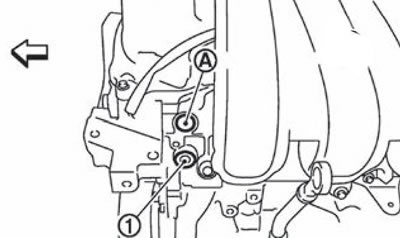
1. Plug.
Note: The arrow in the figure shows the front of the engine.
Attention.
- Be careful not to touch rotating parts (drive belts, pulleys, etc.)
- Use rags to prevent oil from splashing onto the person doing the work, onto the outer surfaces of the engine and onto the body surfaces. Be especially careful that oil does not get onto the rubber parts of the drive belts, engine mounting cushions, etc. If oil does get onto surfaces, remove it immediately.
5. If engine oil does not flow out from the intake valve timing solenoid valve hole in the cylinder head, perform the following check:
- Remove and clean the oil filter.
- Clean the oil groove between the strainer and the intake valve timing control solenoid valve.
6. Remove the components between the intake valve timing solenoid valve and the camshaft sprocket, then check all oil grooves for blockages.
7. After checking, install the removed parts in the reverse order.