


Powertrain Mounting Components
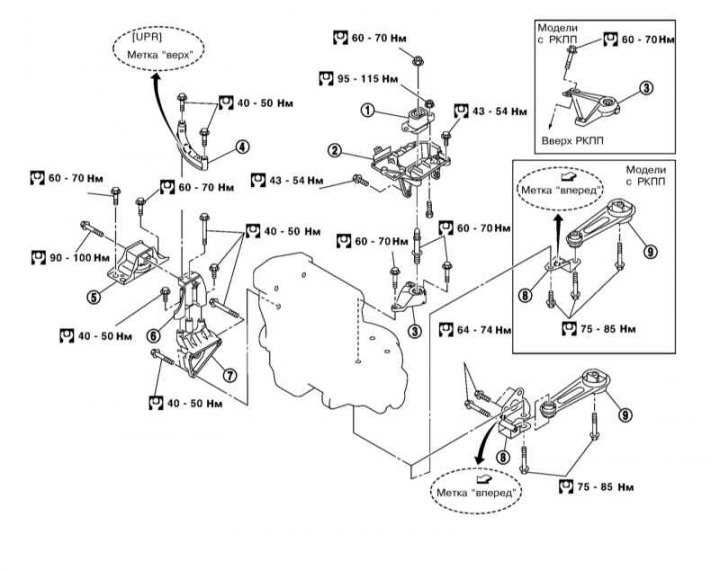
1 - Left support cushion; 2/3 - Left support bracket (from the body/transmission side); 4 - Right support stand; 5 - Right support cushion; 6/7 - Right support bracket (left/right); 8 - Rear support bracket; 9 - Rear support
1. Park the car on a level, hard surface and cover the front fenders with protective covers or, for example, old blankets.
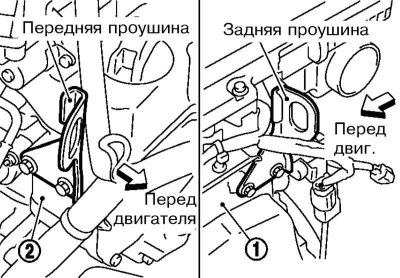
2. If not installed, install lifting eyes on the front left and rear right sides of the cylinder head. For front side installation, remove the wiring bracket under the fuel rail guard.
3. Release the pressure in the fuel system (see section Relieving pressure in the fuel system).
4. Drain the engine oil and coolant (see sections Changing engine oil and oil filter and Replacing the coolant).
5. Remove the following components:
- Front wheels and front wheel arch liners;
- The front section of the exhaust pipe (see Chapter Fuel and exhaust systems);
- Drive belts (see section Replacement of auxiliary drive belts and intermediate belt rollers);
- Air intake tract (see section Removal and installation air intake tract components);
- Battery;
- Radiator of the cooling system (see Chapter Engine cooling, heating, ventilation and air conditioning systems).
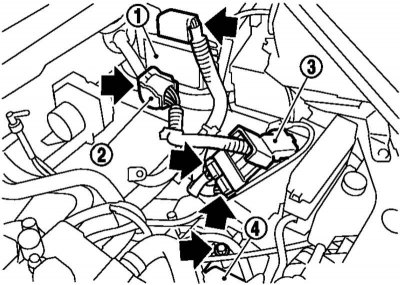
6. Remove the ECM (1) from the bracket and disconnect the two ECM connectors. Disconnect the main wiring harness connector (2).
7. Disconnect the positive battery cable (3) and the ground cable (4) on the transmission side.
Note: The location of the ground wire on models with manual transmission differs from that shown in the illustration above for models with automatic transmission.
8. Disconnect the heater hose and immediately plug it to prevent coolant loss.
9. Disconnect the gear selection and shift cable from the transmission (models with manual transmission, see Chapter Manual gearbox and clutch), or the AT mode selector lever cable (see Chapter Automatic transmission).
10. On models with Manual transmission disconnect the clutch pipe from the manual transmission side, plug the pipe and temporarily secure it to the car body.
11. Remove the CKP sensor from the transmission.
12. Remove the ground wire between the generator bracket and the body.
13. Remove the right engine mount stand, generator bracket and generator.
14. Remove the air conditioning compressor without disconnecting the pipes from it, move the compressor to the side and secure it with a rope to the body elements so that the pipes are not loaded.
15. Remove the fuel rail protection (see section Removal and installation of fuel injectors and fuel distribution line).
16. Disconnect the fuel pipe and immediately plug it to prevent fuel leakage.
17. Remove the wheel sensors and brake calipers from the steering knuckles. Hang the calipers on body elements so that the brake lines are not loaded.
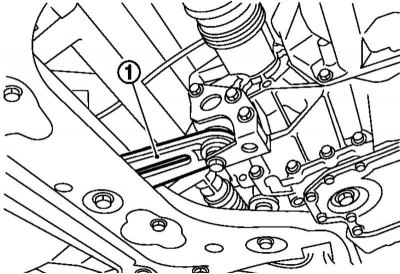
18. Remove the drive shafts (see Chapter Drive shafts, steering knuckles and hub assemblies) and the rear engine mount.
19. Suspend the engine on the winch using the lifting eyes.
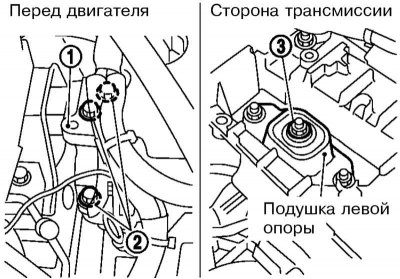
20. Unscrew the bolts (2) of the upper bracket (1) of the right engine support and the lock nut (3) of the left support.
21. Place a lifting trolley under the engine, lower the engine onto it and remove the power unit from under the vehicle.
Note: Be careful not to touch any components in the engine compartment to avoid damage to them or the powertrain.
22. Remove the starter and separate the transmission from the engine (see section Removal and installation the intake manifold or Removal and installation the exhaust manifold, catalytic converter and lambda probe).
23. Installation is performed in the reverse order of component dismantling. Make sure the support cushions are intact and replace them if necessary.
24. After installation, before starting the engine, check the levels of the working fluids and adjust them if necessary.
25. Start the engine and check for fuel and fluid leaks, abnormal noises and vibrations.
26. Let the engine idle, then turn it off and check the fluid levels again.